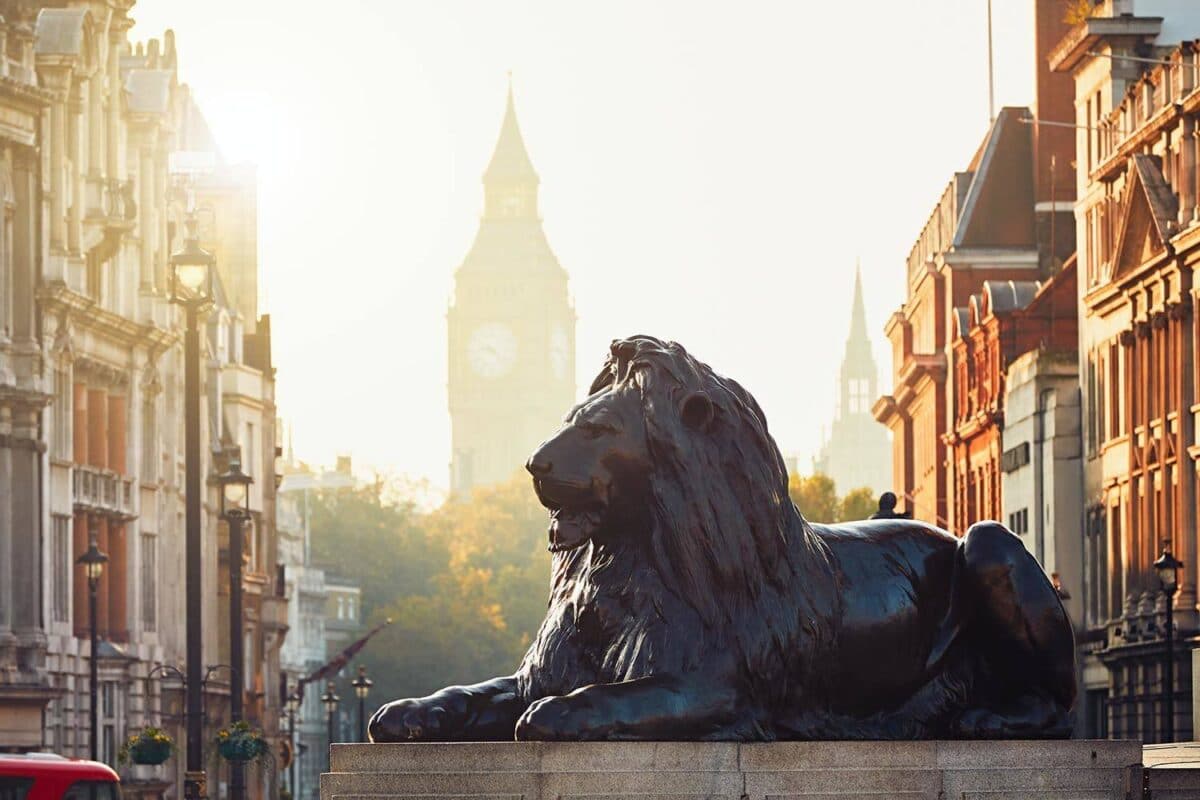
Look at any photo of Trafalgar Square and you’ll notice that the imposing Nelson’s Column is surrounded by four rather casual-looking lions. But do you know why these lions were chosen?
Fear not, as we’re about to lift the lid on the hidden secrets of the Trafalgar Square lions.
The popular tourist hotspot Trafalgar Square, right in the heart of Westminster, is no stranger to interesting sculptures – like The Fourth Plinth or the smallest police station in London, for example – but these lion sculptures have a very interesting history that makes them worth a visit.
Seriously, it’s a miracle they’re even here today.
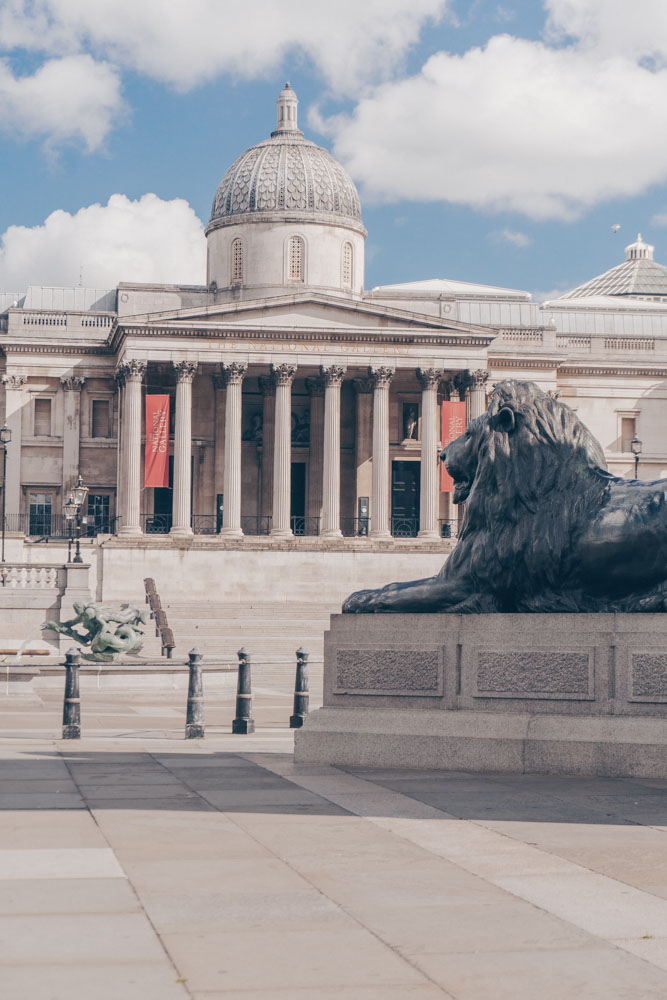
Each of the four lions are pretty much identical except for slight differences in their mane and head (whether this was on purpose or not, nobody really knows). And while these creatures don’t have official names, they have acquired the nickname ‘The Landseer Lions’ after the man who sculpted them.
It’s said that each of these 7-ton statues will awaken if Big Ben ever chimed 13 times… and that’s not even the weirdest secret that these big cats hold in their paws.
Strap yourself in, this is a very wild ride.
Why did they choose lions?
During the planning of Nelson’s Column, the committee in charge had decided that four lions at the base of the plinth would be a brilliant addition to the design.
They wanted something to represent the heroism of Lord Nelson and decided that these creatures were more than fitting. Funding and a difference of opinion made it very difficult, though, for a solid decision to be made.
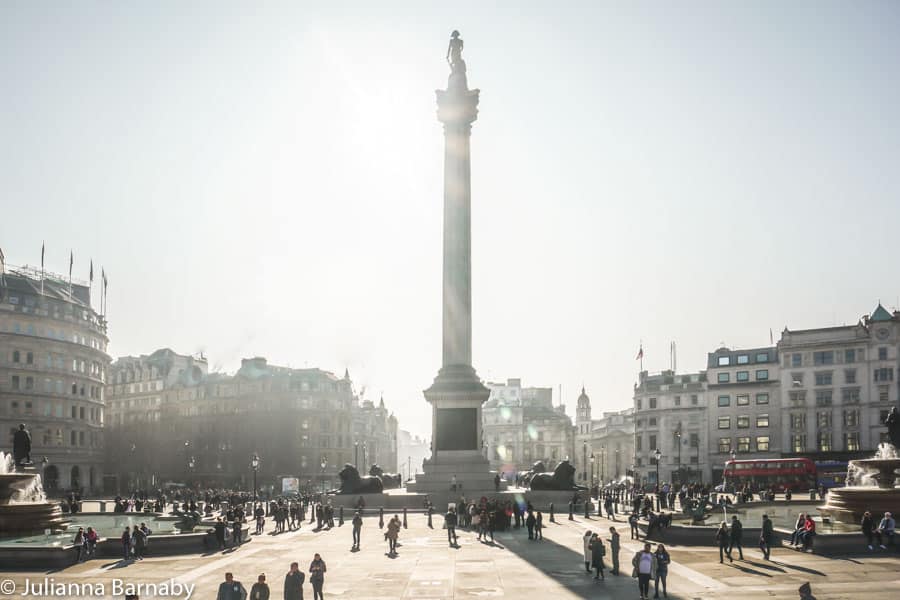
Nelson’s Column itself was built between 1840 and 1843, minus the four lions, which were still years away. The committee continued arguing over the lions until 1846, when finally they were given enough funding to commission their ideal design.
Why were the lions in Trafalgar Square so controversial?
To put it simply, the planning and designing of the Trafalgar Square lions was a complete and utter shambles. Absolutely everything, from initial meetings to the actual design process, was filled with obstacles and disagreements that the committee needed to navigate.
Despite having secured the funding for the lions 12 years prior, it wasn’t until 1858 that the ball finally began to get rolling. Told you… a shambles.
The House of Commons funded £6000 for the lions to be completed and then announced that they wanted six of the most talented sculptors to submit their ideas, from which the winning design would be selected.
As you can guess, The Board of Works disagreed with this. They went completely against the House of Commons and instead chose to select Sir Edwin Landseer to design the lions. Job done, right? Wrong.
This was a controversial decision, because while Landseer was famed for his portrait work of Queen Victoria and his pretty paintings of various animals, he had yet to prove himself as a talented sculptor.
Landseer was also in poor health and the committee suffered even more financial problems, which caused yet more delays to the lions’ unveiling.
It was originally thought that the lions would be standing, mouths wide and roaring into the crowd. Although, it was much cheaper for them to be laid down, and rumour has it that Queen V thought that the roaring pose was much too shocking for a public square.
Local newspapers reported on the whole saga, branding it as a ‘national disgrace’ and a ‘scandal’. This was perpetuated even further when an extra £11,000 was needed so that Baron Carlo Marochetti (an actual sculptor) could carry out the casting of the lions.
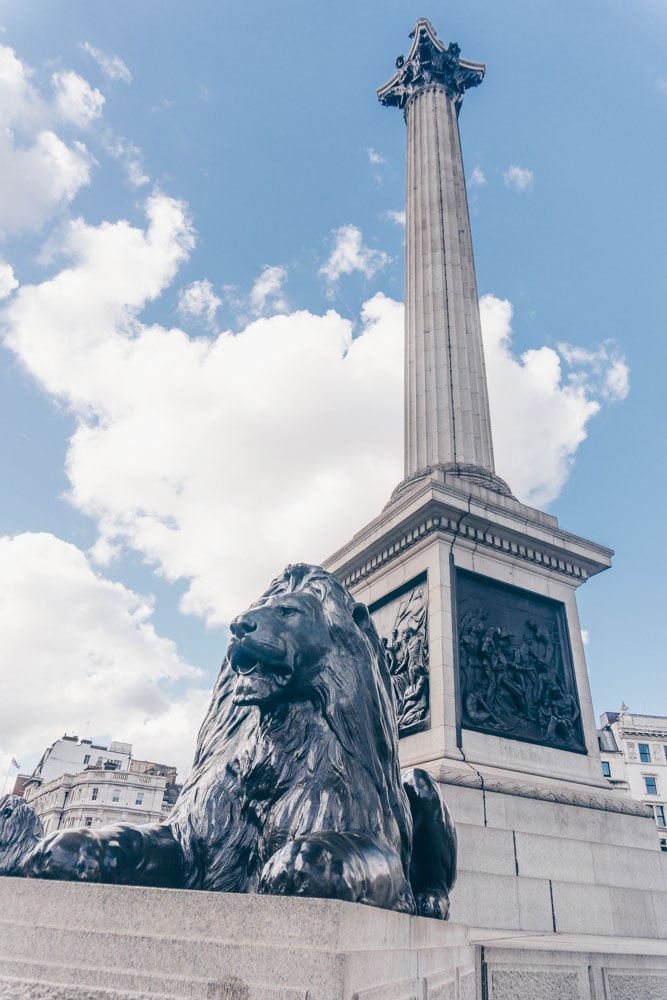
After decades of kerfuffle, you’ll be glad to know that the lions of Trafalgar Square were finally unveiled to the public on 31st January 1867, although to a mixed reception.
What are the Trafalgar Square lions made from?
Although at the time there were plenty of debates over what the statues should have been crafted from, it was eventually decided that the Trafalgar square lions were to be made from cannons.
This decision came after Thomas Milnes had previously unveiled four lions made from stone. His lions were labeled unimpressive – the committee thought that Nelson deserved bigger and better – and instead his lions were bought by Titus Salt and sent to the village of Saltaire.
Funnily enough, you can still see what were technically the original lions in the village near Bradford today.
When it came to Nelson’s dazzling lions, though, plain old stone cannons would not do. Oh no no. The big cats were cast in bronze that was from the French and Spanish ships that were defeated in the Battle of Trafalgar. It’s basically one big ‘ol humble brag sitting in the centre of the capital.
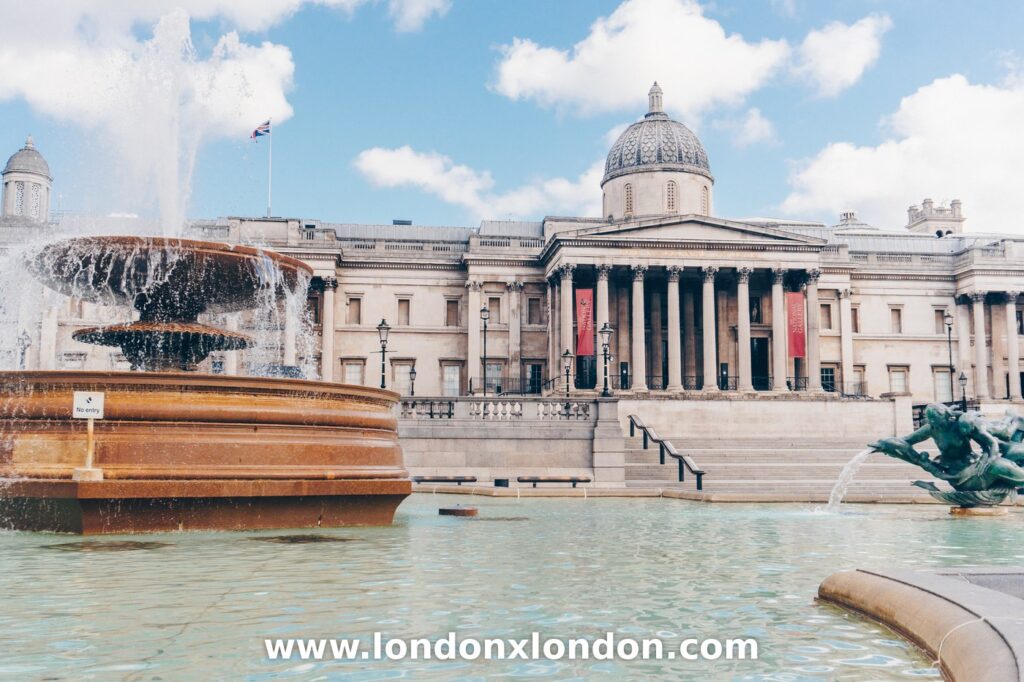
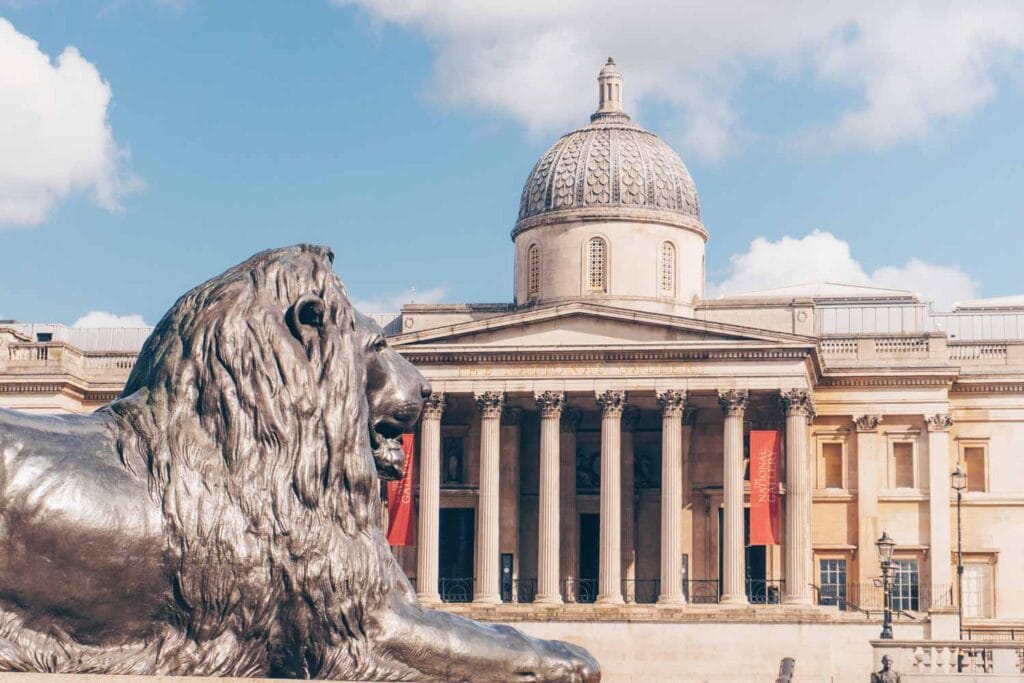
It’s fitting, in a way, that they spend their days facing the National Gallery, home to one of the best art galleries in London, given that Landseer himself was a painter first and a rather reluctant sculptor second.
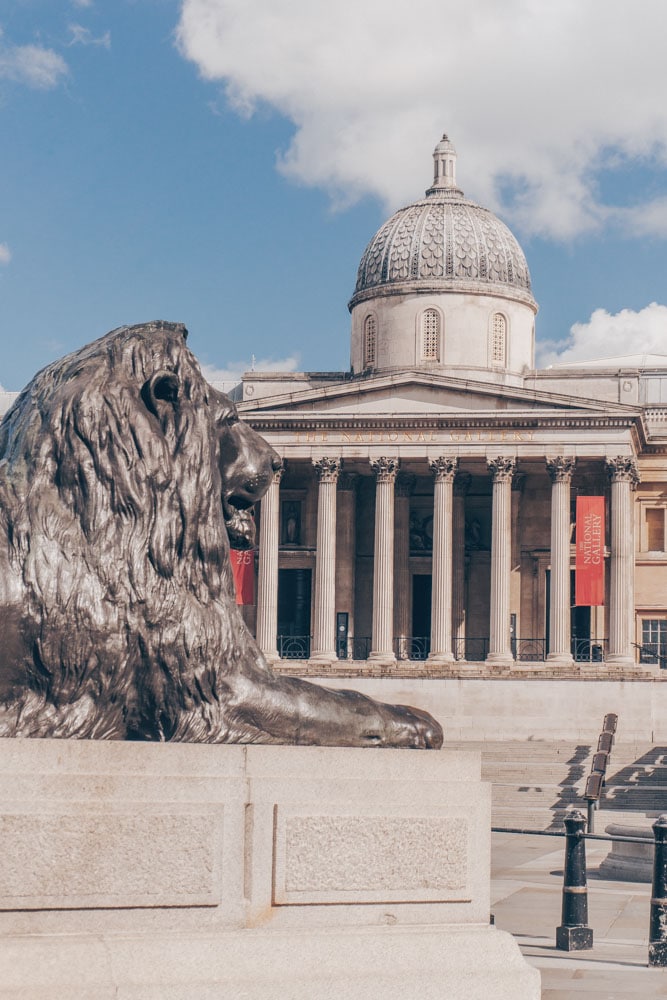
At the time, it was an extremely rare occurrence to see a lion in real life, and obviously, Landseer couldn’t just nip onto Google to get himself a reference image. So he had to get creative.
In order to combat this conundrum, he spent some time badgering the London Zoo, who eventually agreed to provide him with a dead lion to serve as the inspiration for the four lions on Trafalgar Square. He did have to wait two years for the poor creature to die, mind you.
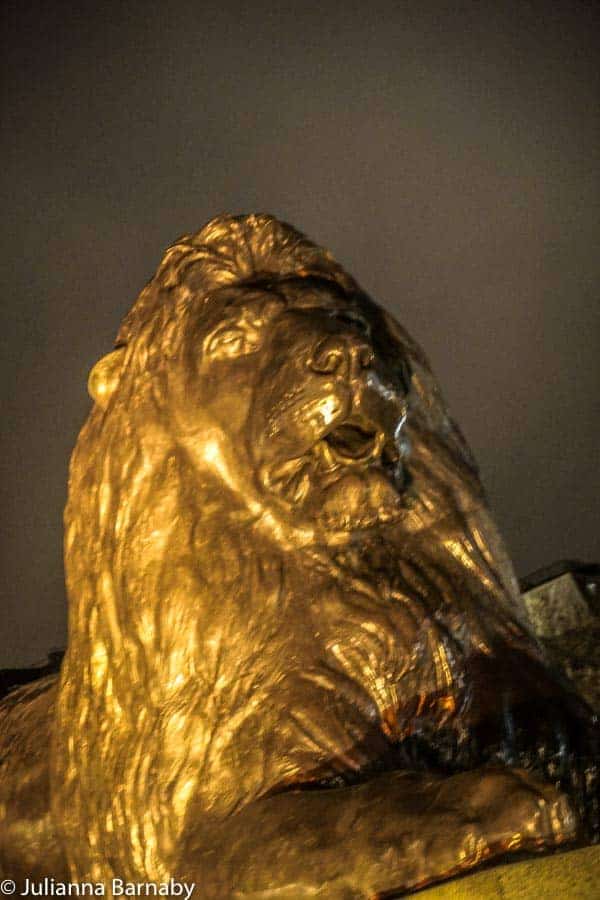
Although, if you look closely at the statue, the Trafalgar lions’ paws look a little bit strange and have a sphinx-like quality to them. Another major issue with the design was that the lions backs were sculpted to be concave, though in real life they are convex when lying down.
These were popular observations that gathered a lot of criticism at the time. Landseer’s lack of sculpting skills came into question again, though, it was a bit late then – it would have been like shutting the gate after the lions had bolted.
Now’s the time to put down your sandwich….
It’s believed that the paws of each lion were sculpted last, and you better believe that Landseer was taking his sweet time with sketching the animal.
By the time he finally got around to looking at the paws, the dead lion had begun to decompose. This left Landseer to fumble through the last of the lion statues with only his imagination and some rather funky-looking paws as a guide.
Edwin Landseer’s lions?
As we’ve already established, Landseer was not known to be a brilliant sculptor.
He had previously painted a series of lions, yet as far as everyone was aware at the time, had no experience with a chisel. Which was pretty worrying, considering he would be let loose with an expensive commission (that went well over budget) for one of London’s main squares.
Despite this, he was a well-respected friend of Queen Victoria and the Royal family, and so he agreed to complete the sculptures. Ah, the power of nepotism.
He worked incredibly slowly, sketching the lion for four years – it’s no wonder the paws weren’t very accurate. He was also often seen hanging around in the Zoological Gardens, studying the (very much alive) lions and their behaviour.
Neither of these things proved to help him very much with the sculpting, though the lions are now a much-loved tourist attraction in themselves.
Whatever happened to Landseer?
Landseer didn’t just sculpt lions. He was one of the most successful painters of the Victorian age, and his 1851 painting The Monarch of the Glen, a Highland stag surveying its territory, became one of the most reproduced images of the era thanks to cheap steel engravings. The original later spent time on public display at the National Gallery, the very building the Trafalgar Square lions look out on, before finding a permanent home at the National Galleries of Scotland in Edinburgh in 2017, following a public fundraising campaign.
His later years were harder. Landseer suffered what is now believed to have been a serious nervous breakdown in his thirties, and for the rest of his life he battled recurring depression, hypochondria and heavy drinking. By 1872, his mental state had deteriorated so much that his family had him declared insane. When he died the following October, at 71, London responded as though it had lost a national treasure: shops lowered their blinds, flags flew at half mast, and his own bronze lions were dressed in mourning wreaths as his funeral cortege passed through the city on its way to St Paul’s Cathedral.
A rallying point as much as a backdrop
The lions have also had a front-row seat to more than a century of London protest. Suffragettes gathered in the square in 1908 and 1909, with Emmeline and Christabel Pankhurst among the speakers, and it has since hosted anti-fascist demonstrations in the 1930s, anti-nuclear ‘Ban the Bomb’ rallies from the late 1950s onwards, and marches against the Vietnam War and apartheid through the 1960s and 70s. Trafalgar Square has arguably been just as important to London’s political life as it has to its tourist trade, and the lions have watched every bit of it.
For decades, the square was also London’s unofficial home for seeing in the new year, with crowds climbing onto the lions and Nelson’s Column and paddling, somewhat riskily, in the fountains at midnight. That informal tradition faded after 2003, when the official fireworks display moved to the Thames, giving Londoners a safer, more organised place to celebrate instead.
Today the lions sit proudly in Trafalgar Square, attracting hordes of tourists who love to climb all over them. When you visit, make sure to take a peek at the kitty-like paws and appreciate the decades of effort it took to finally get them erected.
That popularity has come at a cost. A conservation survey found cracking, corrosion and sections of bronze worn to just a fifth of an inch thick in places, around a third the thickness of unworn areas nearby, largely from generations of visitors using the tails as a step up onto the statues’ backs. Replacing a single lion was estimated at around £180,000, and officials even discussed stationing heritage wardens, of the kind used in Paris, to discourage climbing. In the end, English Heritage recommended against an outright ban, preferring to keep the lions under regular review instead. Climbing is still tolerated for now, but we would encourage a gentler touch with these grand old cats.
How do they compare to London’s other big cats?
The Landseer lions aren’t the only big cats keeping watch over London. At the southern end of Westminster Bridge, in the heart of Westminster, stands the South Bank Lion: a solitary, 13-ton figure cast not in bronze but in Coade stone, a remarkably durable ceramic material. It started life in the 1830s on top of the old Lion Brewery on the South Bank, survived a fire and the brewery’s demolition, and was moved to its current spot in 1966. It is older than the Trafalgar Square lions by three decades, considerably heavier, and, being cast as a single figure rather than four separate statues, has needed far less conservation work over the years.
Hopefully you’ll agree it was well worth it.
The London x London take
We think the Trafalgar Square lions are one of those landmarks we all walk past a hundred times without really looking at, which is a shame, because up close they are far stranger and more charming than any postcard lets on. Once we knew the backstory, it was hard not to smile at those slightly wrong, cat-like paws every time we passed.
Our advice is to visit early in the morning, before the coach parties and the queues for photos, when it is easier to get close enough to study the mane and paws properly. Bring the story of Landseer’s decomposing lion carcass with you, and we promise you will never look at the crowds draped over these statues in quite the same way again. Once you’re done, Covent Garden is a short walk east and makes for a natural next stop.
The Trafalgar Square lions: practical information and map
Address: Trafalgar Square, Charing Cross, London WC2N 5NJ
Looking for more London guides?
- Ultimate London bucket list
- The Fourth Plinth
- Insider’s guide to Trafalgar Square
- Westminster: an insider’s area guide
- Covent Garden: an insider’s area guide