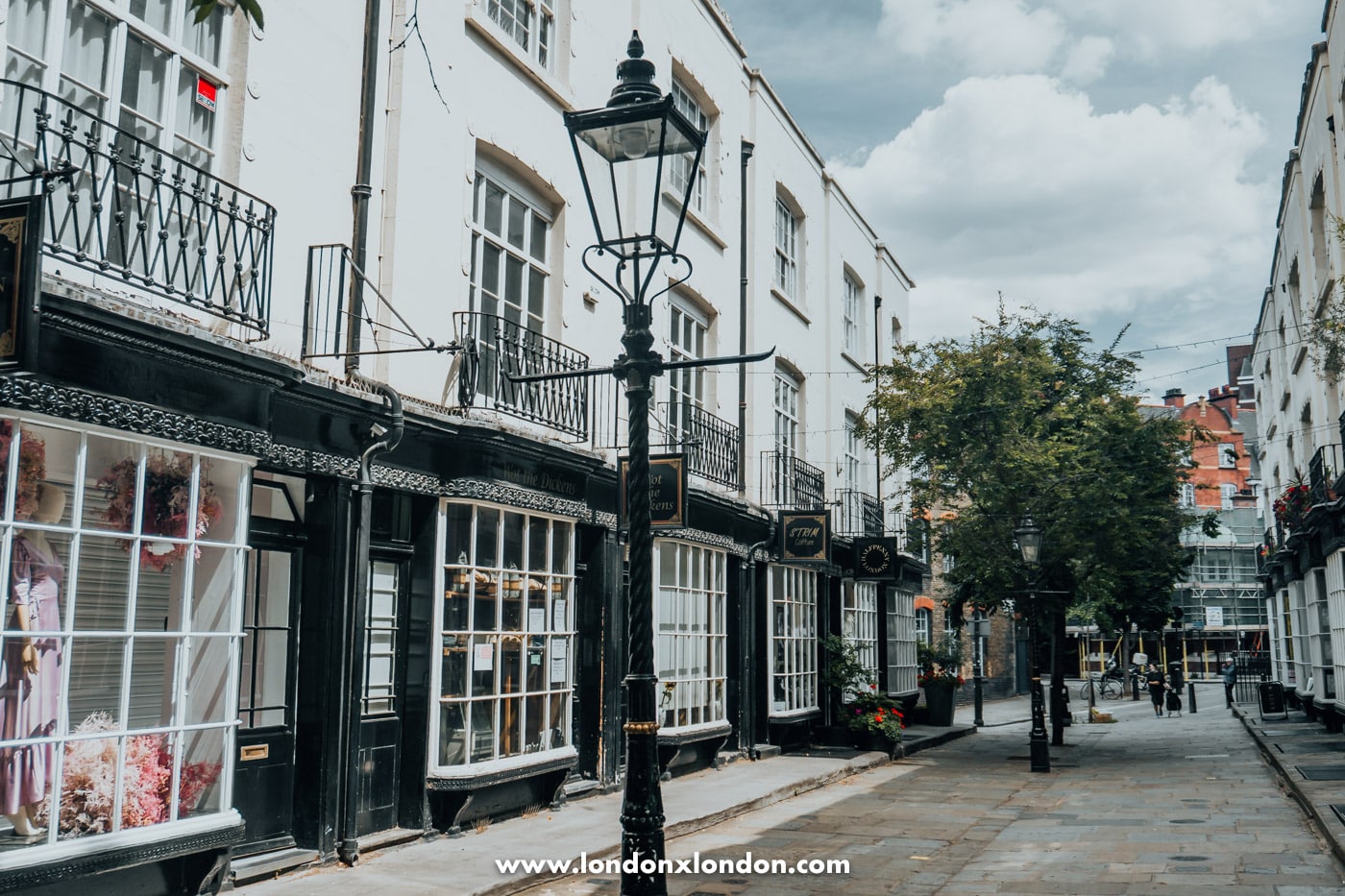
Woburn Walk is a pedestrianised pocket of 1822 London, tucked between Bloomsbury and King’s Cross, where WB Yeats held court for twenty-four years and a literary pioneer invented stream of consciousness fiction.
There aren’t many bits of London near King’s Cross and Euston that feel genuinely beautiful, but Woburn Walk is one of them. A short pedestrianised street just on the Bloomsbury side of the divide, it’s one of those places that stops you in your tracks: a row of bow-fronted Georgian shopfronts in cream and stucco, original iron gas lamps, and an atmosphere that somehow resists the twenty-first century entirely.
Think of it as a grander, prettier cousin to Covent Garden’s Goodwin’s Court. Better preserved, more spacious, and with a considerably more interesting backstory.
The history of Woburn Walk
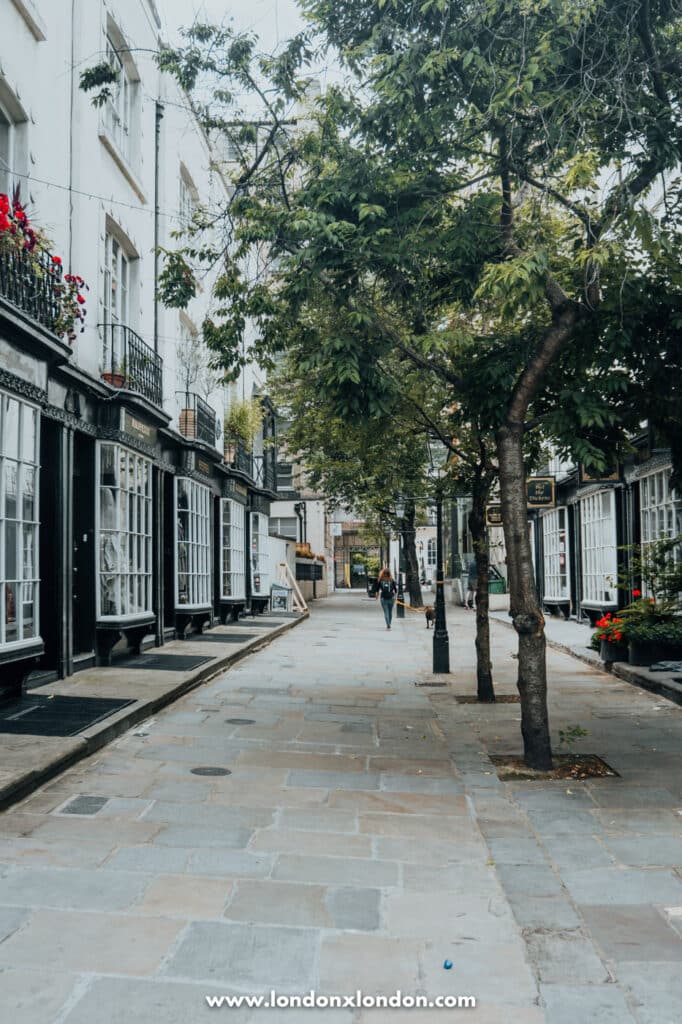
Woburn Walk was built in 1822, designed by Thomas Cubitt, who was also responsible for much of Belgravia and Pimlico. (It was his brother William who designed the east front of Buckingham Palace, a distinction that tends to get muddled.) Named after Woburn Abbey, the country seat of the Dukes of Bedford, Cubitt designed the street specifically for pedestrian use, making it the first pedestrianised shopping street in London.
The bow-fronted shops and cream buildings are almost perfectly preserved. Many of the stucco-fronted houses are Grade II listed, and the street edges the courtyard of the New St Pancras Church. At the time it was built, the area was considerably rougher than it looks now: when WB Yeats moved in, his neighbours called him “the toff” because he was the only person in the street who received letters.
WB Yeats at number 5
Yeats lived at number 5 Woburn Walk from 1895 to 1919, making it the longest he ever lived anywhere. He moved here partly because he needed rooms private enough to conduct his first love affair, with the novelist Olivia Shakespear, an arrangement that required a trip to a Tottenham Court Road furniture shop to purchase a double bed. He recorded the experience as deeply traumatic, noting that every inch of width added to the expense.
The flat became one of the great literary salons of its era. Every Monday evening Yeats held open house, and the sitting room, decorated with tall candles in massive candlesticks, William Blake engravings, busts of poets and piles of books, filled with London’s literary world. Ezra Pound was a regular, and made himself thoroughly at home, freely distributing Yeats’s cigarettes and Chianti to other guests.
During his twenty-four years at number 5, Yeats wrote some of the most significant poetry in the English language. He co-founded the Abbey Theatre in Dublin. He became a Nobel laureate. He was also, throughout most of this period, a member of the Hermetic Order of the Golden Dawn, a secret occult society, which he kept rather quiet. A blue plaque marks the house today.
Dorothy Richardson and the invention of stream of consciousness
Dorothy Richardson lived at Woburn Walk for a year between 1905 and 1906, and the street appears fictionalised in her thirteen-volume novel sequence Pilgrimage, the work that established her reputation and then, unfairly, failed to sustain it.
Richardson is one of those writers whose influence vastly outran her fame. She was the first novelist in English to develop the stream of consciousness technique as a sustained literary form, predating both James Joyce’s Ulysses and Virginia Woolf’s Mrs Dalloway. May Sinclair, reviewing her work in 1918, was the first person ever to apply the phrase “stream of consciousness” to a piece of literature: it was coined in response to Richardson’s writing. Woolf acknowledged the debt. Richardson, largely forgotten today, deserves considerably better.
Visiting Woburn Walk
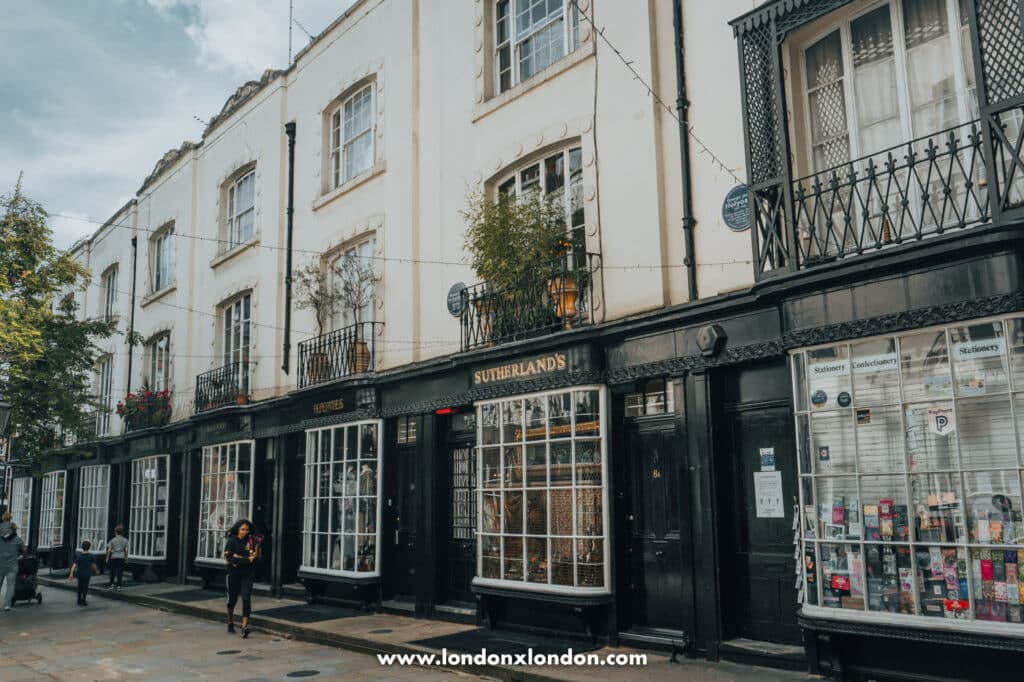
The street is a few minutes’ walk from Euston and Russell Square stations and is entirely free to wander. The shops are a mix of independent traders and cafes. It’s at its best on a quiet weekday morning, when you can walk the length of it without encountering many people and genuinely feel like you’ve stepped into a different century.
The London x London Take: Woburn Walk is one of those spots that rewards knowing the story. The Georgian streetscape is beautiful on its own terms. Add in Yeats holding court with Ezra Pound for twenty-four years, and Dorothy Richardson quietly inventing one of the most important techniques in modern fiction around the corner, and you have one of the more extraordinary small streets in London.