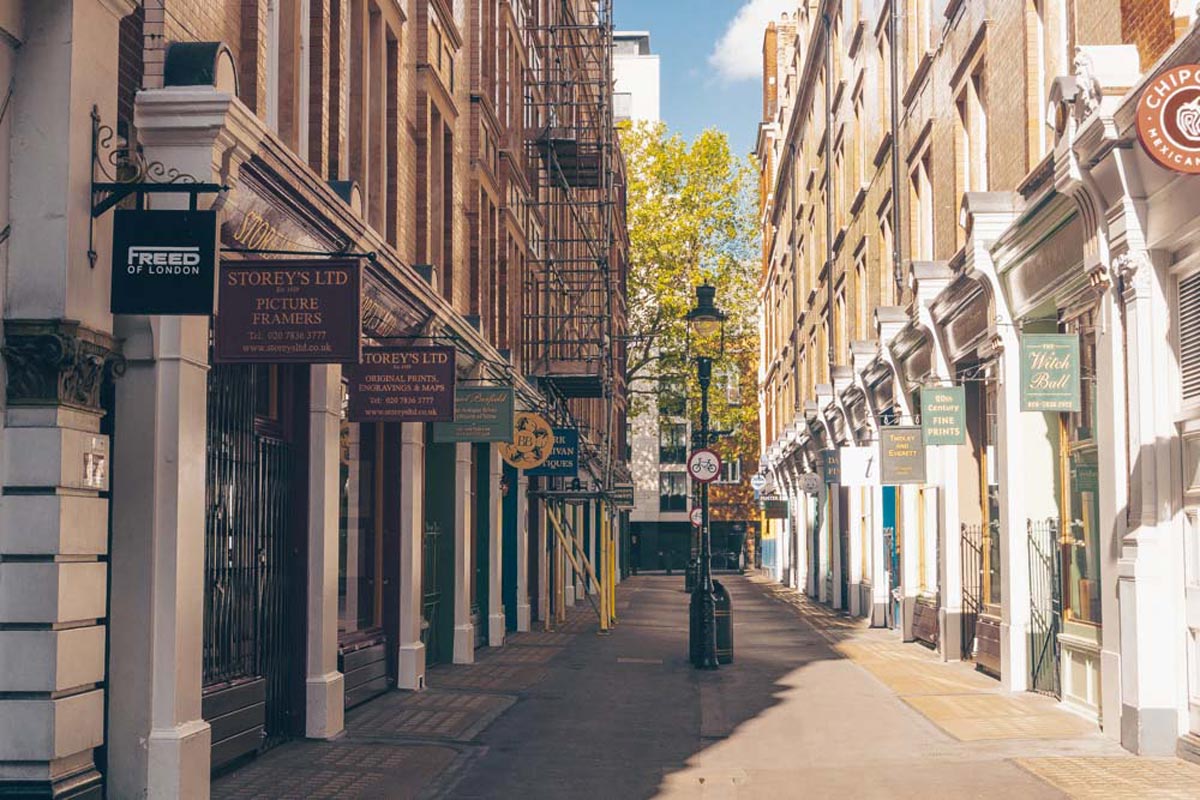
Somebody in Cecil Court got so tired of this that they put up a sign. It read: “Harry Potter has nothing to do with this street. Ask your tour guide and get your money back.”
They have a point. J.K. Rowling has addressed the question directly, more than once, and the answer is not ambiguous. In July 2022 she wrote: “No real street inspired Diagon Alley, I’m afraid. It came out of my head! I’ve never seen 99% of the places that claim to be the inspiration.” Two years earlier, on Diagon Alley and Knockturn Alley together: “Neither was based on any real place.”
Which leaves an obvious question, given that hundreds of people a day go looking for it. So here is the honest version, in three parts: what the books actually describe, which London streets the films genuinely used, and where you can walk down a Diagon Alley that exists.
What the books actually describe
Diagon Alley is reached through the Leaky Cauldron, and the pub is the only part with a real-world address attached to it. Here is the description from the fifth chapter of Philosopher’s Stone, when Hagrid takes Harry there for the first time:
“a tiny, grubby-looking pub. If Hagrid hadn’t pointed it out, Harry wouldn’t have noticed it was there. The people hurrying by didn’t glance at it. Their eyes slid from the big book shop on one side to the record shop on the other as if they couldn’t see the Leaky Cauldron at all.”
So: a pub between a bookshop and a record shop, invisible to anyone who is not a wizard. Through the bar is a small walled courtyard with nothing in it but a dustbin and some weeds, and Hagrid taps a particular brick three up and two across with his umbrella. The wall folds itself into an archway.
Charing Cross Road is named in the books, which is where the confusion starts, but not until Deathly Hallows. It is not in Philosopher’s Stone at all. The most detailed description of the pub itself comes in Prisoner of Azkaban, where Harry spends a fortnight upstairs in room eleven, eating in the bar and doing his homework.
The alley beyond holds Gringotts, Ollivanders, Flourish and Blotts, Madam Malkin’s, Eeylops Owl Emporium, the Apothecary, Quality Quidditch Supplies and Gambol and Japes, with Knockturn Alley running off it. None of them exists. That is the whole point of the archway.
Rowling has ruled out almost every candidate
The Diagon Alley denial is not a one-off. She has also publicly ruled out Victoria Street in Edinburgh, Gandy Street in Exeter (“nothing like the Diagon Alley in my head”), the Shambles in York, which she says she has never visited, and Livraria Lello in Porto (“it has nothing to do with Hogwarts!”).
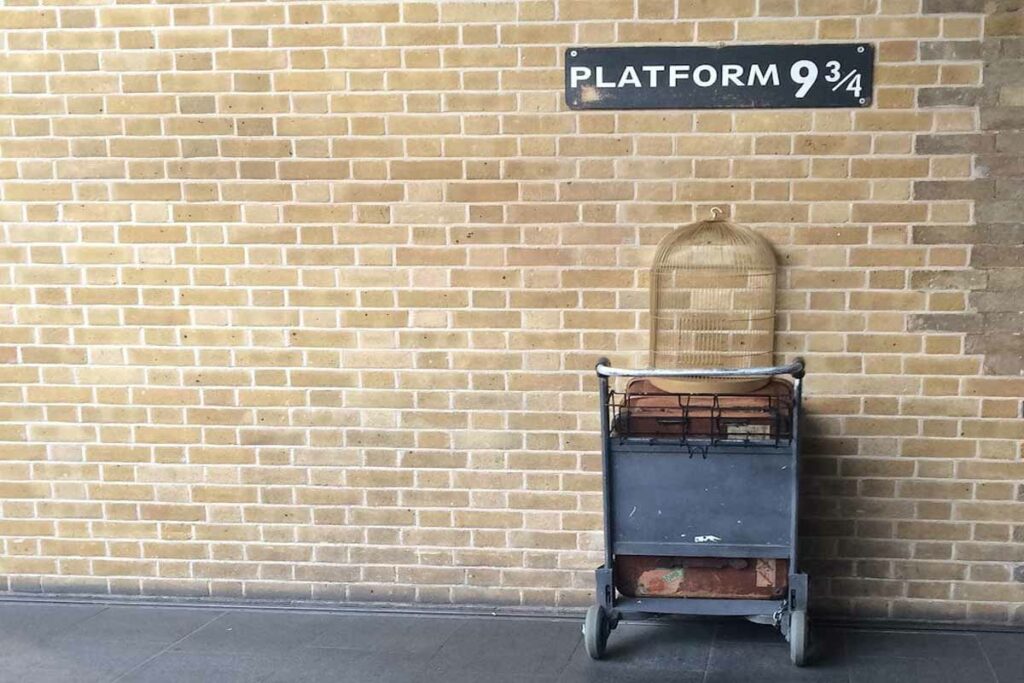
The one London location she has confirmed matters to her is King’s Cross, and not for the reason people assume. Her parents met on a train pulling out of it. “For me, King’s Cross is a very very romantic place,” she told the BBC in 2001, “probably the most romantic station, purely because my parents met here.” That is a biographical fact about Platform 9¾, not about Diagon Alley.
So what is Cecil Court?
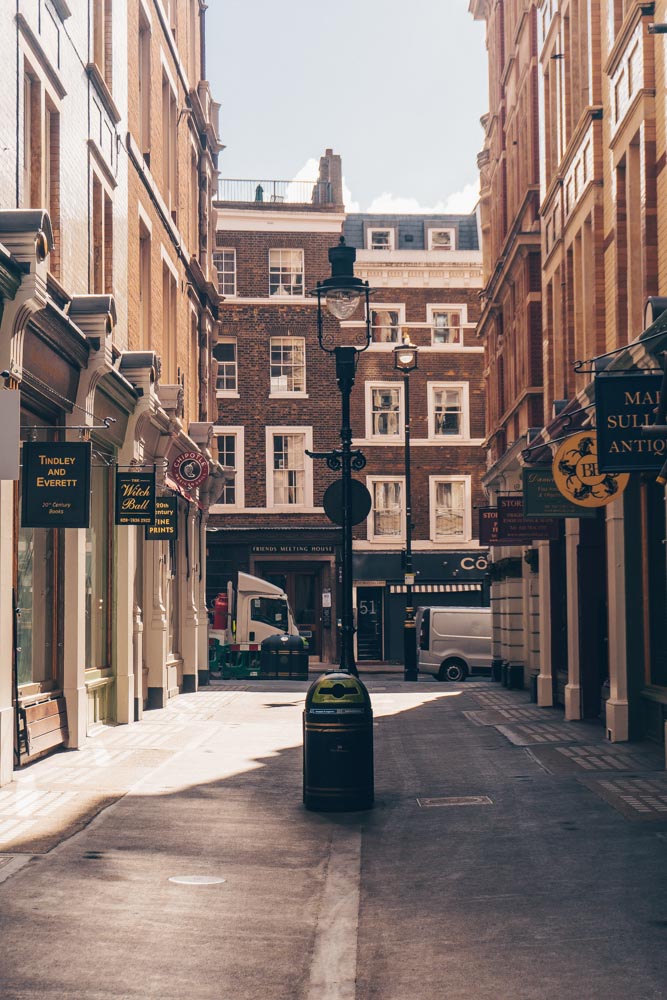
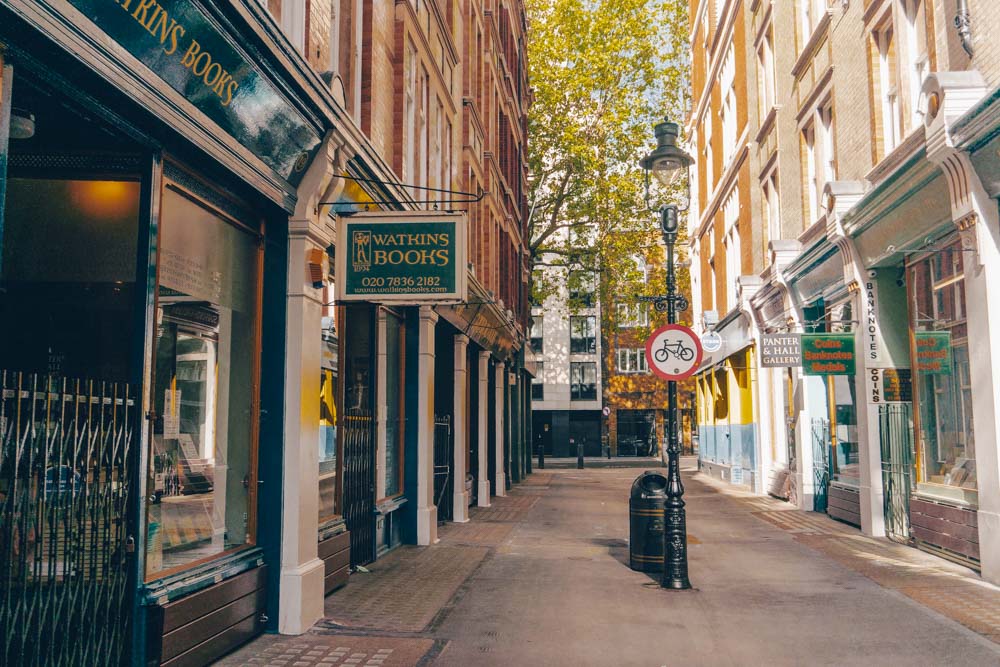
A genuinely lovely Victorian alley off Charing Cross Road, lined with antiquarian booksellers, and the single most-photographed “Diagon Alley” in London. There is no evidence Rowling has ever mentioned it.
The real history is better than the invented one. Four houses here burnt down in 1735 in a fire that started in Elizabeth Calloway’s brandy shop, along with nine more on St Martin’s Lane, and Queen Caroline sent fifty guineas to the victims. It was rebuilt from 1885 under Lord Salisbury. In the early days of cinema it was known as Flicker Alley and housed something like forty film companies. The booksellers arrived later, displaced when Holywell Street was demolished, turning it into a new Booksellers’ Row.
Go for that, not for the wand shops. Our full guide to Cecil Court has the detail.
And Goodwin’s Court?
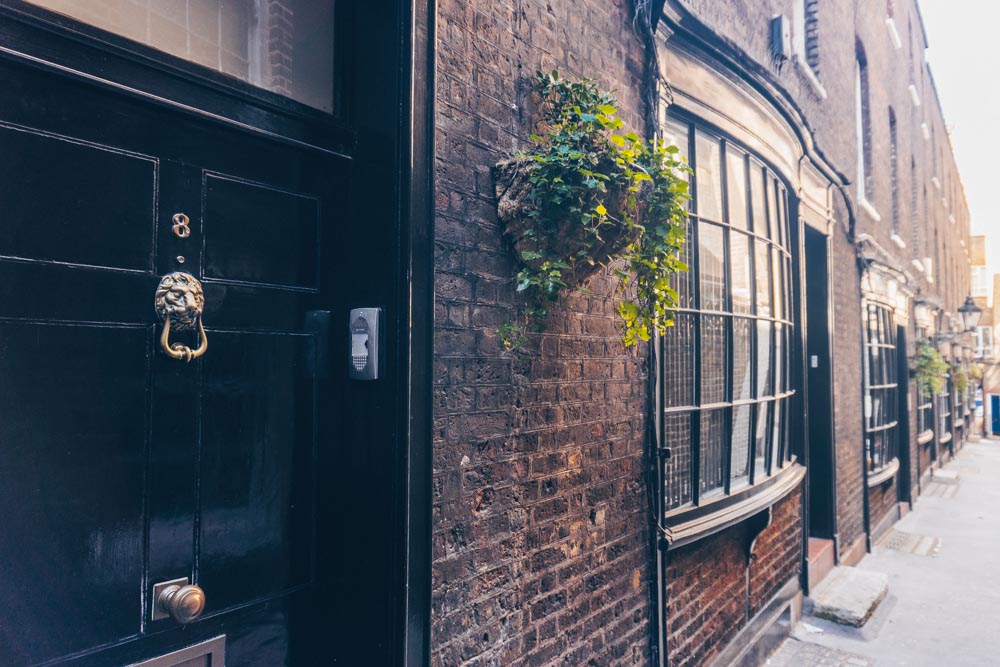
Weaker still. Goodwin’s Court is a run of Georgian bow-fronted shopfronts between St Martin’s Lane and Bedfordbury, about 85 metres long and barely two metres wide, and it is one of the most atmospheric corners of central London. It was reportedly scouted for the films and never used. There is no Rowling connection and no production connection either.
It is still worth five minutes of your time, which is roughly what it takes. See our Goodwin’s Court guide, and the rest of the neighbourhood in things to do in Covent Garden.
Where the films actually shot Diagon Alley
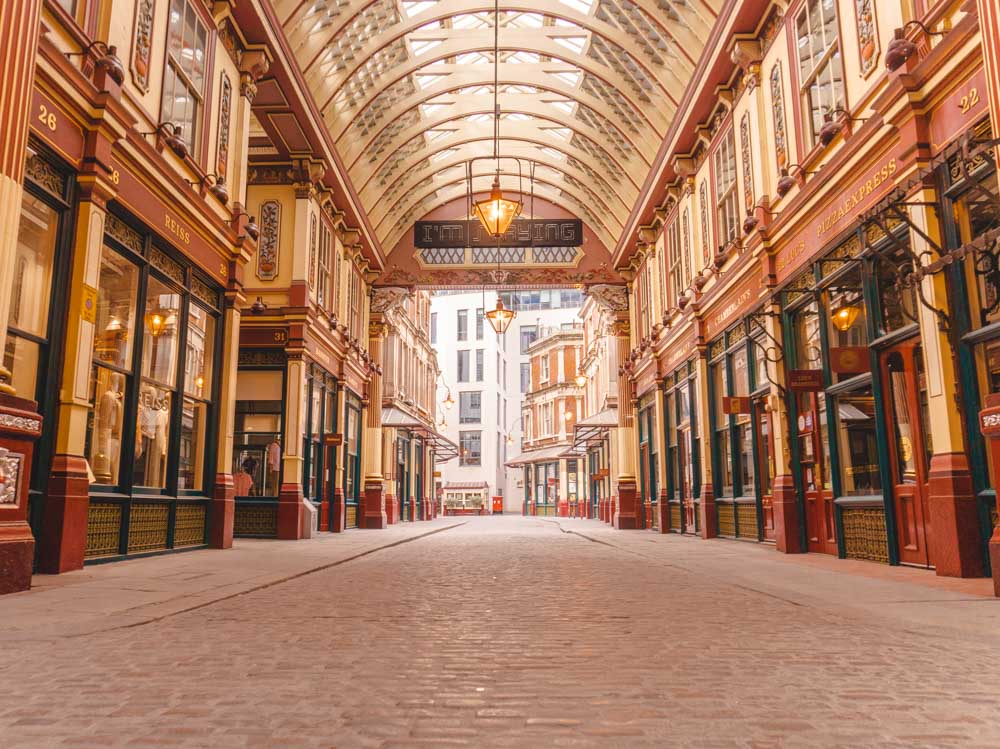
Diagon Alley itself was built as a set at Leavesden and has never been a real street. What the films did use, for the approach and for two specific addresses, is real and walkable.
Leadenhall Market, for the Leaky Cauldron door
Bull’s Head Passage, Leadenhall Market, EC3V 1LU · free, public · nearest tube Monument or Bank
In Philosopher’s Stone, Hagrid and Harry walk through the market’s painted Victorian ironwork and go in through a blue door. Everything past the door is set; the market is the approach.
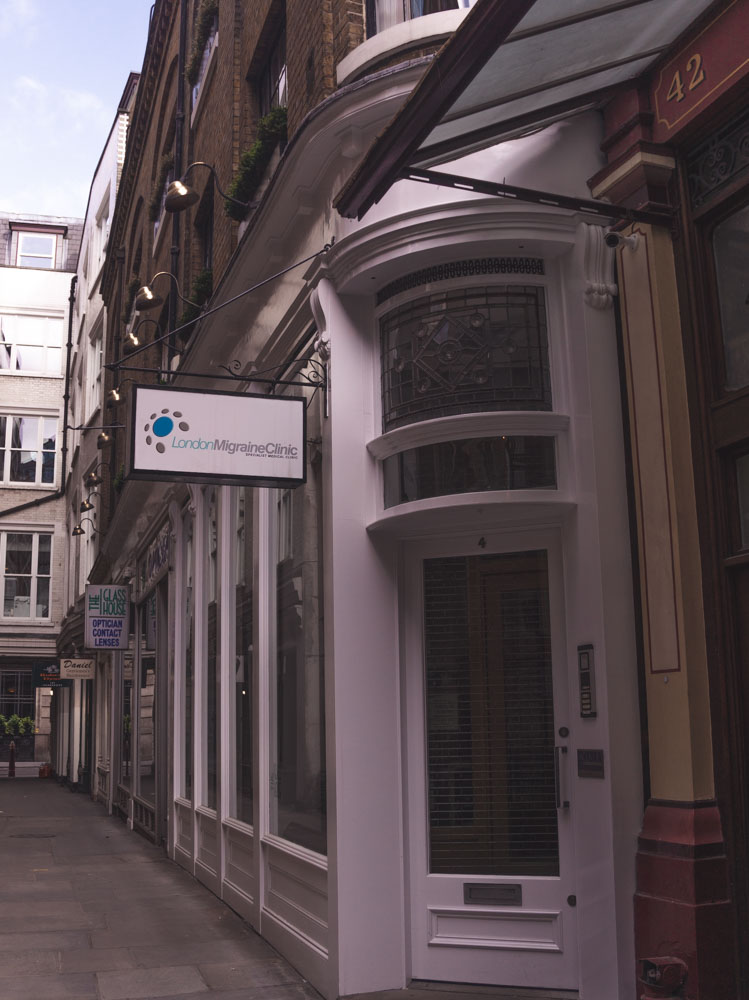
The door is the bow-fronted one at number 4, in Bull’s Head Passage off the main arcade. It is white now rather than the blue it wore on screen, and it sits beneath signs for The Glass House Opticians and the London Migraine Clinic. Two Eyes Coffee House, which shares it, says as much on its own website.
While you are standing there, look at the red shopfront immediately to the right: it carries the number 42. That is almost certainly why half the guides online send people to 42 Bull’s Head Passage, which is the wrong door.
Worth knowing: this is the first film only. And because Leadenhall is in the City, it is deserted at weekends and the cafes are shut. Go on a weekday if you want the place alive. More in our Leadenhall Market guide and our City of London guide.
Stoney Street, for the darker version
7 and 8 Stoney Street, SE1 · free, public · nearest tube London Bridge
By Prisoner of Azkaban the tone had changed and the production wanted somewhere grimmer, so the Leaky Cauldron moved south of the river to Stoney Street, under the railway bridge on the edge of Borough Market.
Number 7 was the pub. Number 8 next door was dressed as the Third Hand Book Emporium, which is a real Diagon Alley shop from the books, so this is the only place in London where a Diagon Alley address has stood on an actual street.
It is thirty seconds from the best food market in the country, so build the visit round lunch rather than the other way round. See our Borough Market guide.
Australia House, for Gringotts
Strand, WC2 · exterior only, you cannot go in
The banking hall of Gringotts in Philosopher’s Stone is the Exhibition Hall inside Australia House, at the eastern end of the Strand where it meets Aldwych. The marble, the chandeliers and the long counters are all real.
You cannot see any of it. Australia House is the Australian High Commission, a working diplomatic mission, and it is not open to the public. This is an exterior-only stop, and a short one.
The only Diagon Alley you can walk down
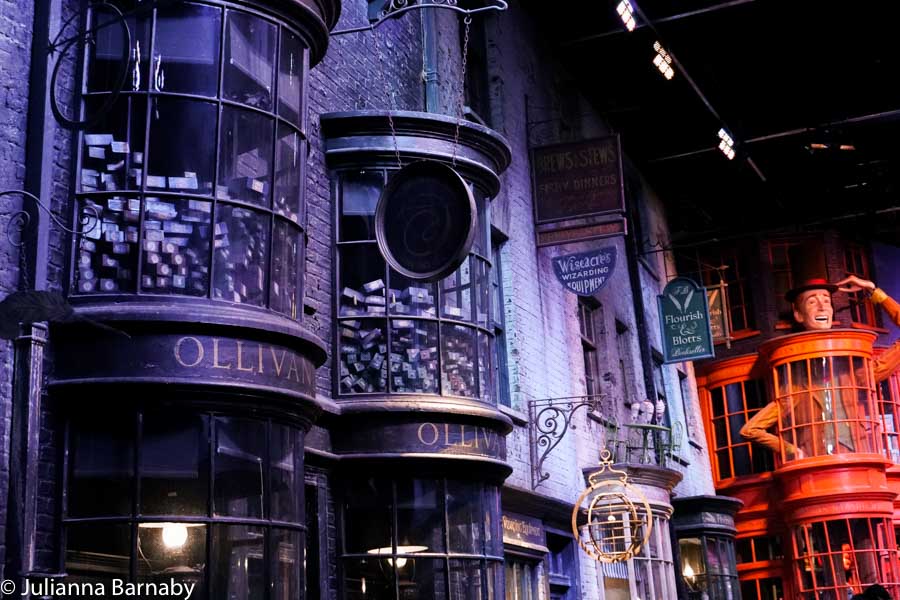
It is at the Warner Bros. Studio Tour, and it is in Hertfordshire rather than London, which is the thing most people get wrong when they plan the day. The address is Studio Tour Drive, Leavesden WD25 7LR, about twenty miles northwest of central London.
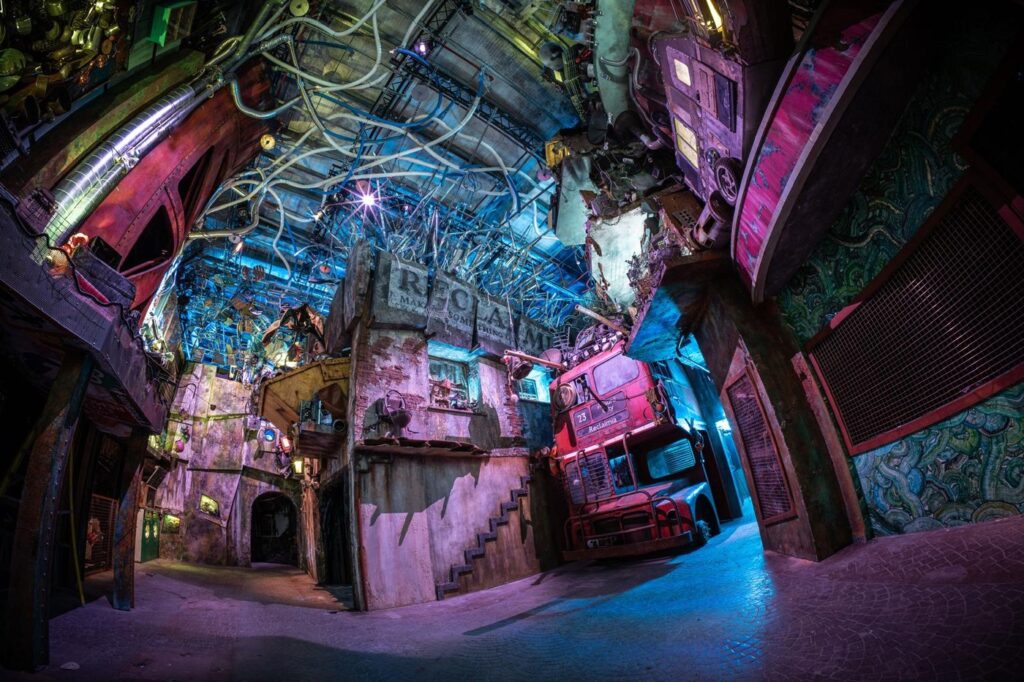
The set is the real thing: cobbles, the shopfronts, Weasleys’ Wizard Wheezes in violent orange, Ollivanders stacked with wand boxes. It is the closest anyone gets to the alley in the books, because it is the alley from the films.
What the set is actually like
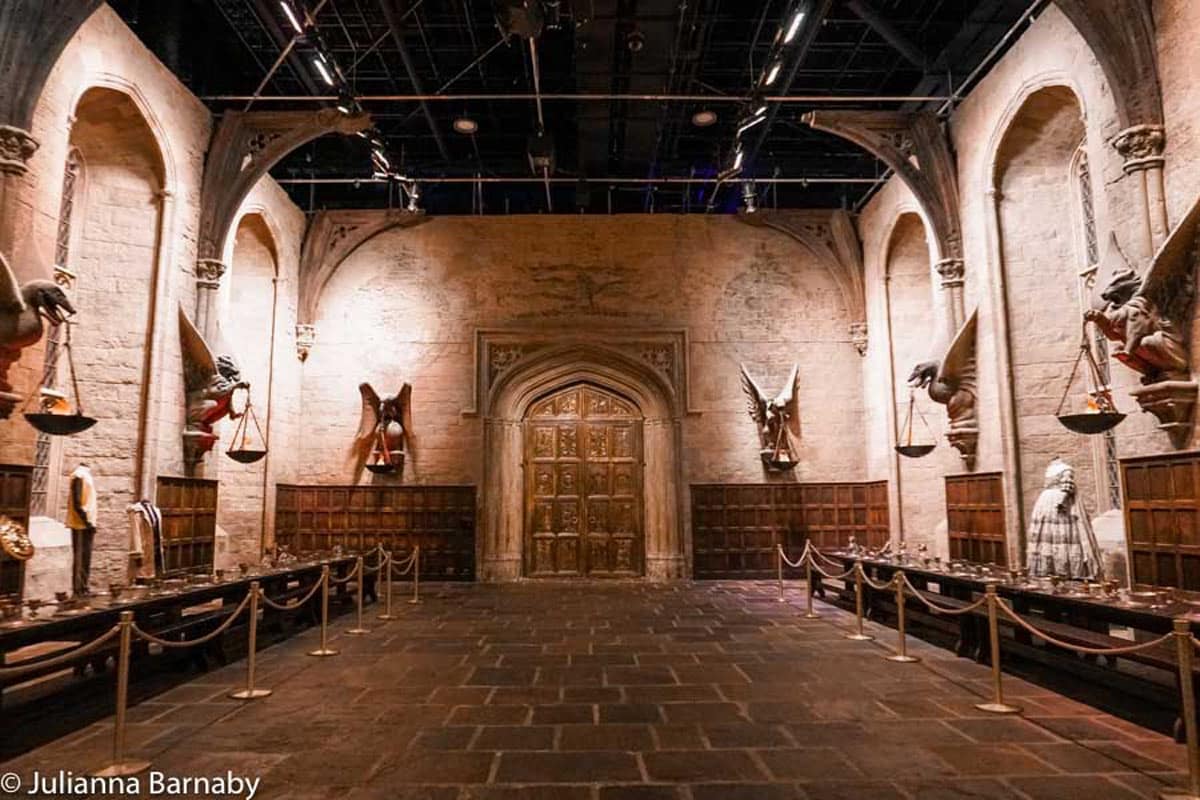
It runs the length of a soundstage and you walk down the middle of it rather than looking at it through glass, which is what makes it work. Weasleys’ Wizard Wheezes is the one that stops people. Ollivanders is stacked floor to ceiling with wand boxes. Stand still for a minute and look up at the signwriting rather than straight ahead, because the shopfronts are where the set decoration is doing its work.
- Tickets for 2026: £58.50 adult, £47 for children aged 5 to 15, under-fours free. It rises to £61 and £48 in 2027.
- Pre-booking is essential. Entry is by timed slot and it is not a walk-up attraction. It sells out regularly, and tickets are released well over a year ahead.
- Getting there independently: Euston to Watford Junction takes about twenty minutes and Oyster is valid on that stretch, then a shuttle bus covers the last fifteen minutes. The shuttle is included with your tour ticket.
- Or take the branded bus. The Studio Tour package with return transport leaves from Victoria on a Warner Bros double-decker and costs around £92 including admission, which saves the faff of two changes with children in tow.
Our full Studio Tour guide covers what to see once you are inside and how long to allow.
If you want to do the walk anyway
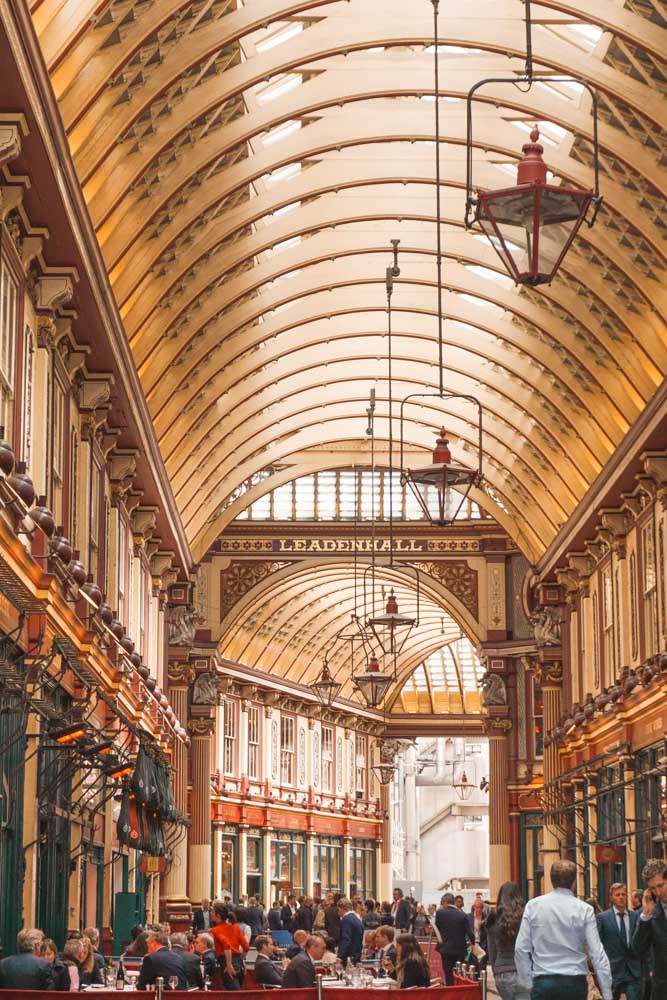
Knowing it is invented does not spoil it. Cecil Court, Goodwin’s Court, Leadenhall and Stoney Street are four of the best-looking corners of central London and you can link them on foot in an afternoon. Start at Leadenhall on a weekday morning, walk west to Stoney Street for lunch at Borough Market, then cross the river to Covent Garden for the two alleys.
If you would rather be told the stories as you go, the Magical London walking tour runs two and a half hours from Southwark and is the best-reviewed of the Harry Potter walks by a wide margin. Our own self-guided Harry Potter walking tour costs nothing, and The Cauldron will let you stir a cocktail with a wand if that is the register you are after.
And to be clear about what is not here: Grimmauld Place, the Ministry of Magic telephone box, the Knight Bus squeezing between two double-deckers, the Millennium Bridge and the reptile house are all real London filming locations, and none of them has anything to do with Diagon Alley. They are all in our guide to Harry Potter locations in London.
For more of this sort of thing, try our lists of quirky and unusual things to do in London and 31 hidden gems in London, or London with kids if the Potter obsession is not yours.
The London x London Take: The best version of this is not a Diagon Alley hunt at all. Do Leadenhall Market on a weekday, when the pubs under the ironwork are full of City workers and the place makes sense, then walk to Stoney Street and eat. You get two genuine filming locations, one of the finest Victorian market halls in Europe and a proper lunch, and you spend nothing. Save the wand shopping for Leavesden, and book that weeks ahead.