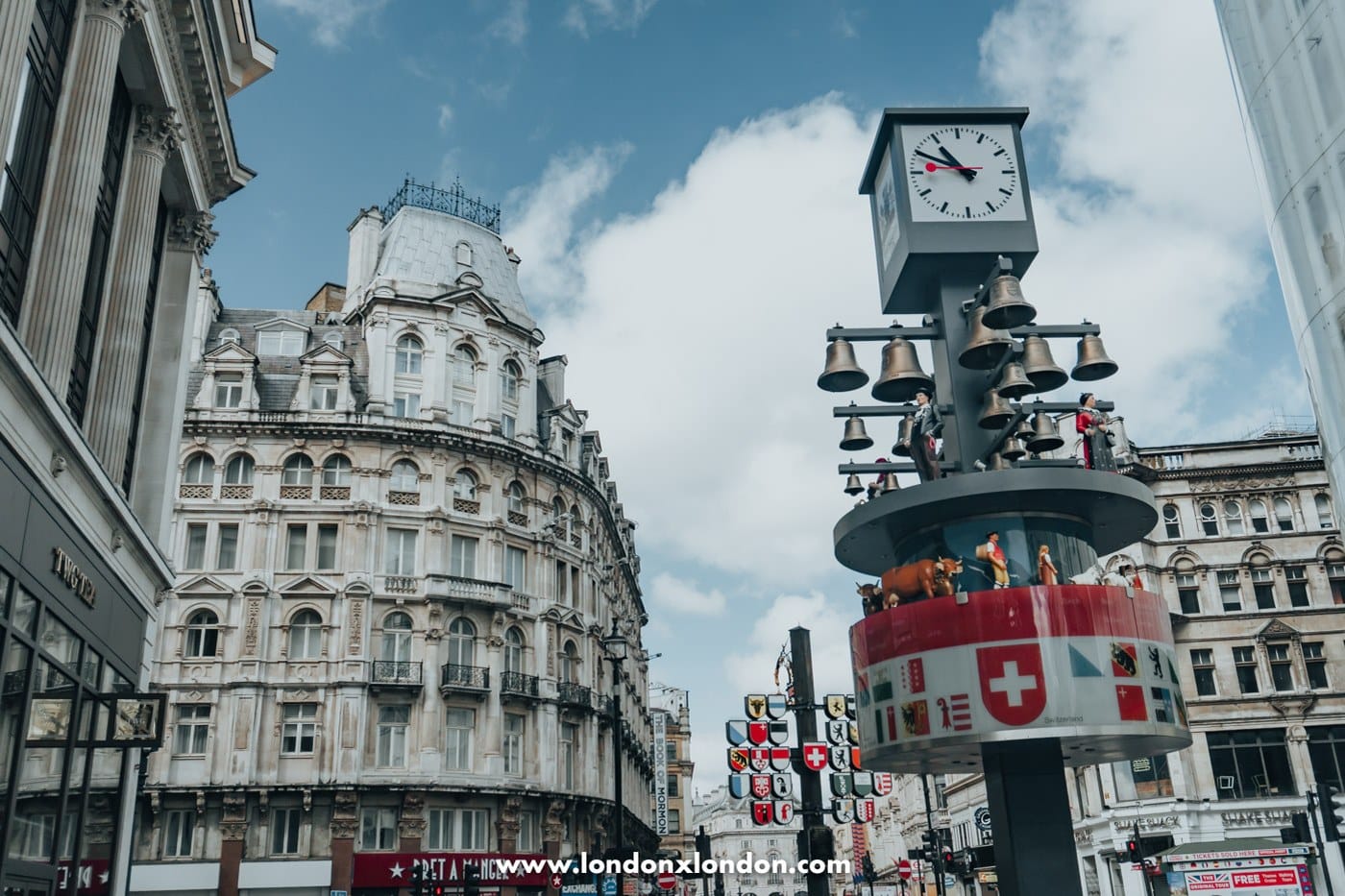
Most people who walk past it assume it is broken. It is not. It is just on a timetable, and the timetable is the single most useful thing in this article.
The Swiss glockenspiel stands in Swiss Court, the small paved space at the Leicester Square end of Coventry Street. It has twenty-seven bells, eleven moving figures and two clock faces, it performs five times a day from Monday to Friday and eight times a day at weekends, and it is operated by remote control from Derby.
The times, because nobody publishes them properly
Every listing we can find says it chimes on the hour. It does not. On a weekday afternoon there is a five-hour gap in which absolutely nothing happens, which is exactly when most people turn up, look at it, decide it has died and walk off towards Chinatown.
- Monday to Friday: noon, 5pm, 6pm, 7pm and 8pm
- Saturday and Sunday: noon, then 2pm, 3pm, 4pm, 5pm, 6pm, 7pm and 8pm
- Each performance: about five minutes
That works out at 2,132 performances a year, which is a number the makers publish and which reconciles exactly with the timetable above. Saturday afternoon is the best bet if you want to build a visit around it. Weekday lunchtime is the other reliable slot, and noticeably less crowded.
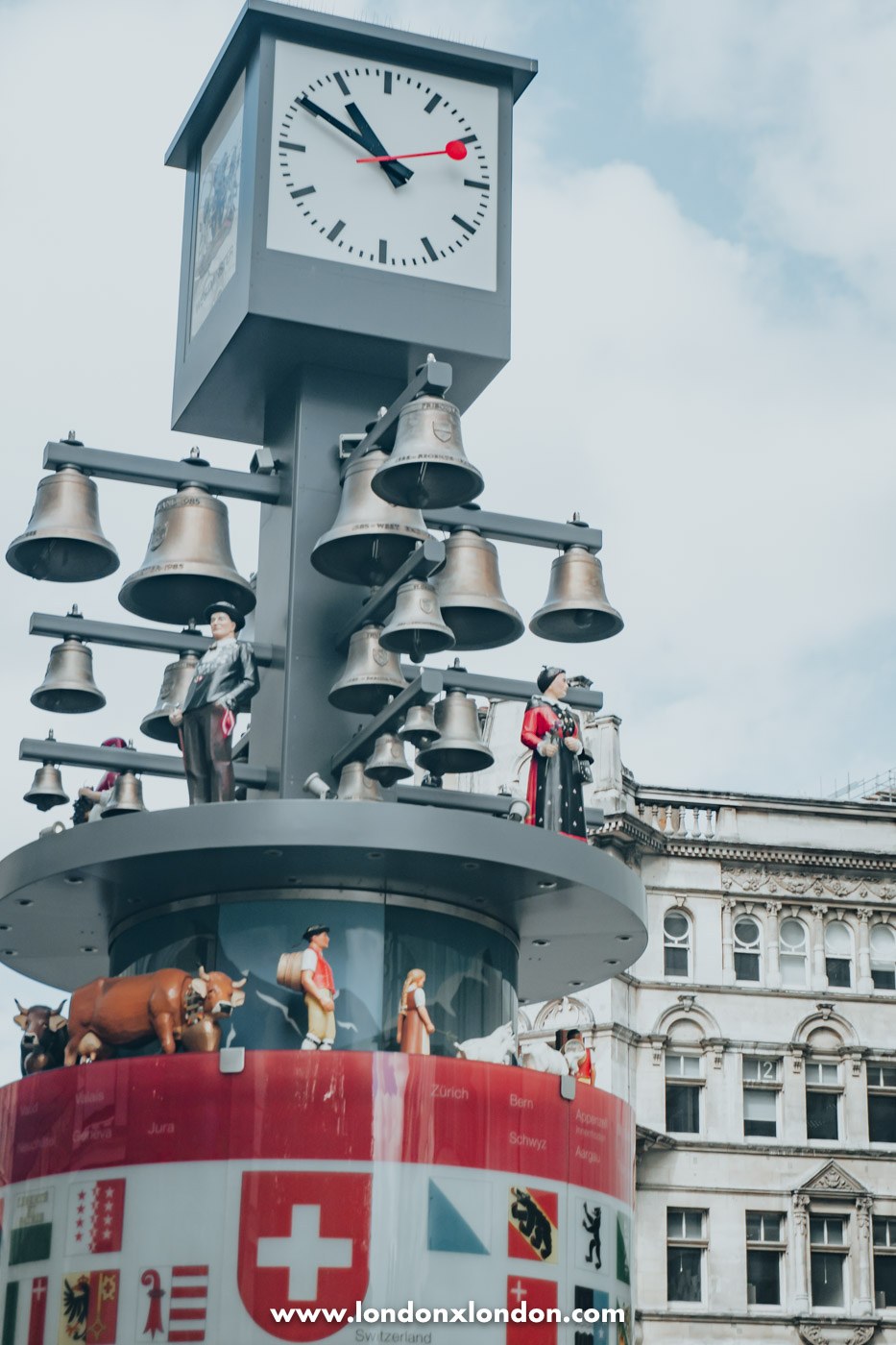
Twenty-seven bells, not twenty-three
You will read almost everywhere, Wikipedia included, that it has twenty-three bells. It has twenty-seven. The bells were cast by H. Rüetschi of Aarau, one of the oldest bell foundries in Europe, and refurbished by the same firm before the instrument went back up.
The twenty-three came from the launch publicity, which made a neat symbolic point about twenty-three Swiss cantons and twenty-three wards of the City of London. Somebody read the symbolism as a hardware spec and it has been copied ever since. The bells have no dampers, which is why the music written for the instrument had to be composed specially rather than adapted from existing tunes, and why it rings on for a beat longer than you expect.
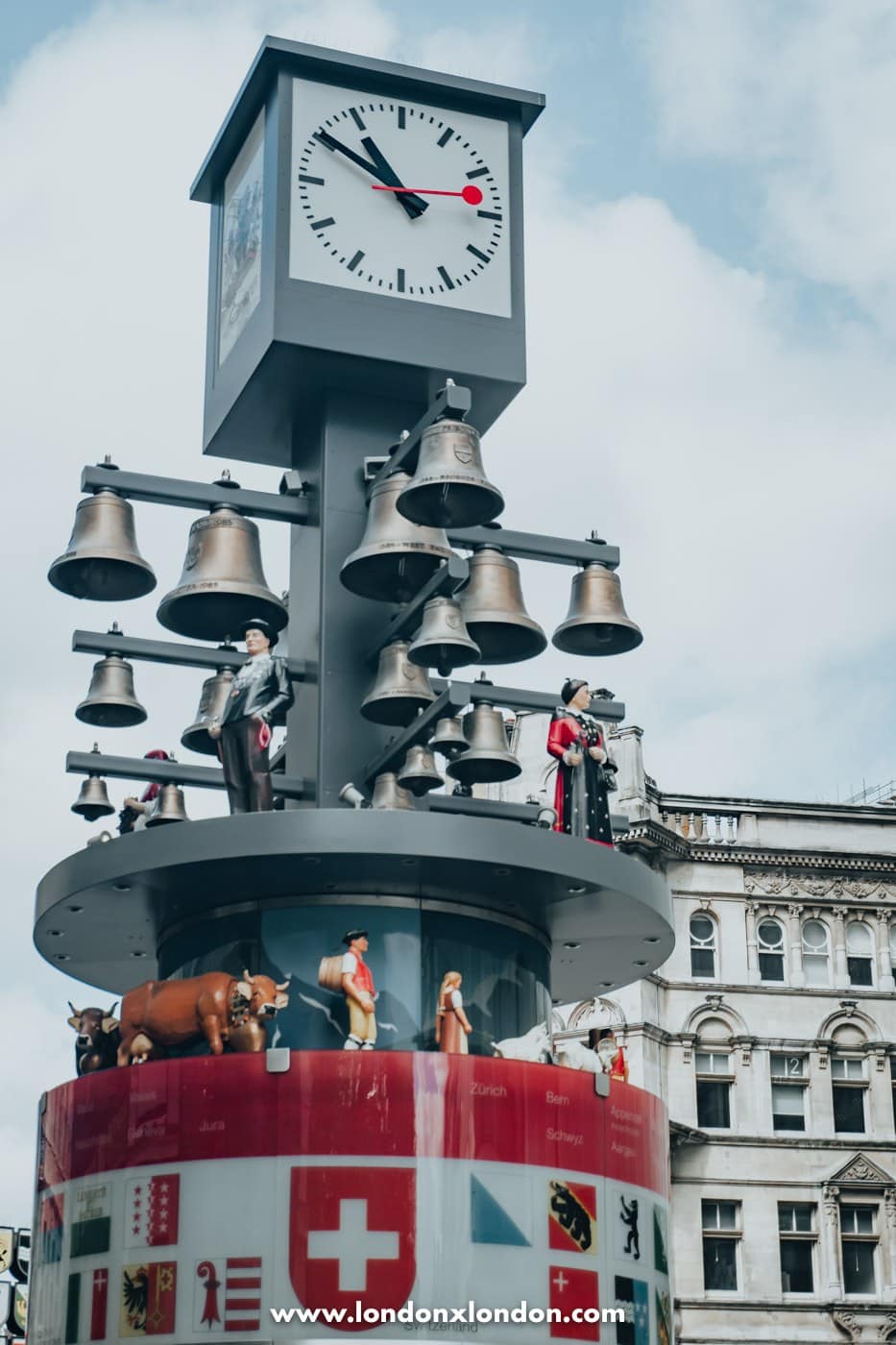
Above the bells sit eleven moving figures, an alpine backdrop and four bell-ringers. The clock faces follow the classic Swiss Federal Railways design that Hans Hilfiker created in 1944, the one with the red second hand shaped like a dispatcher’s signalling baton. Stand and watch a full minute and you can see the hand complete its sweep early and pause at the top before the minute jumps.
It is run from Derby
The glockenspiel was a gift from Switzerland and Liechtenstein, installed in 1985 on the front of the Swiss Centre, the fourteen-storey David Aberdeen tower that stood on this corner from the late sixties. It chimed for the last time on that building on 21 September 2007. The Swiss Centre came down in 2008.
It was rebuilt and re-erected as a freestanding structure by Smith of Derby, the clockmakers, and inaugurated at half past twelve on 28 November 2011. Six alphorn players were stationed on rooftops around Leicester Square for the occasion, which is the sort of thing we would have liked to have been at.
The consequence of that rebuild is our favourite fact about it. The whole instrument is controlled wirelessly from the company’s headquarters in Derby. A Swiss clock in the West End, keeping Swiss time, run from the East Midlands.
The pole of shields is an antique pub sign
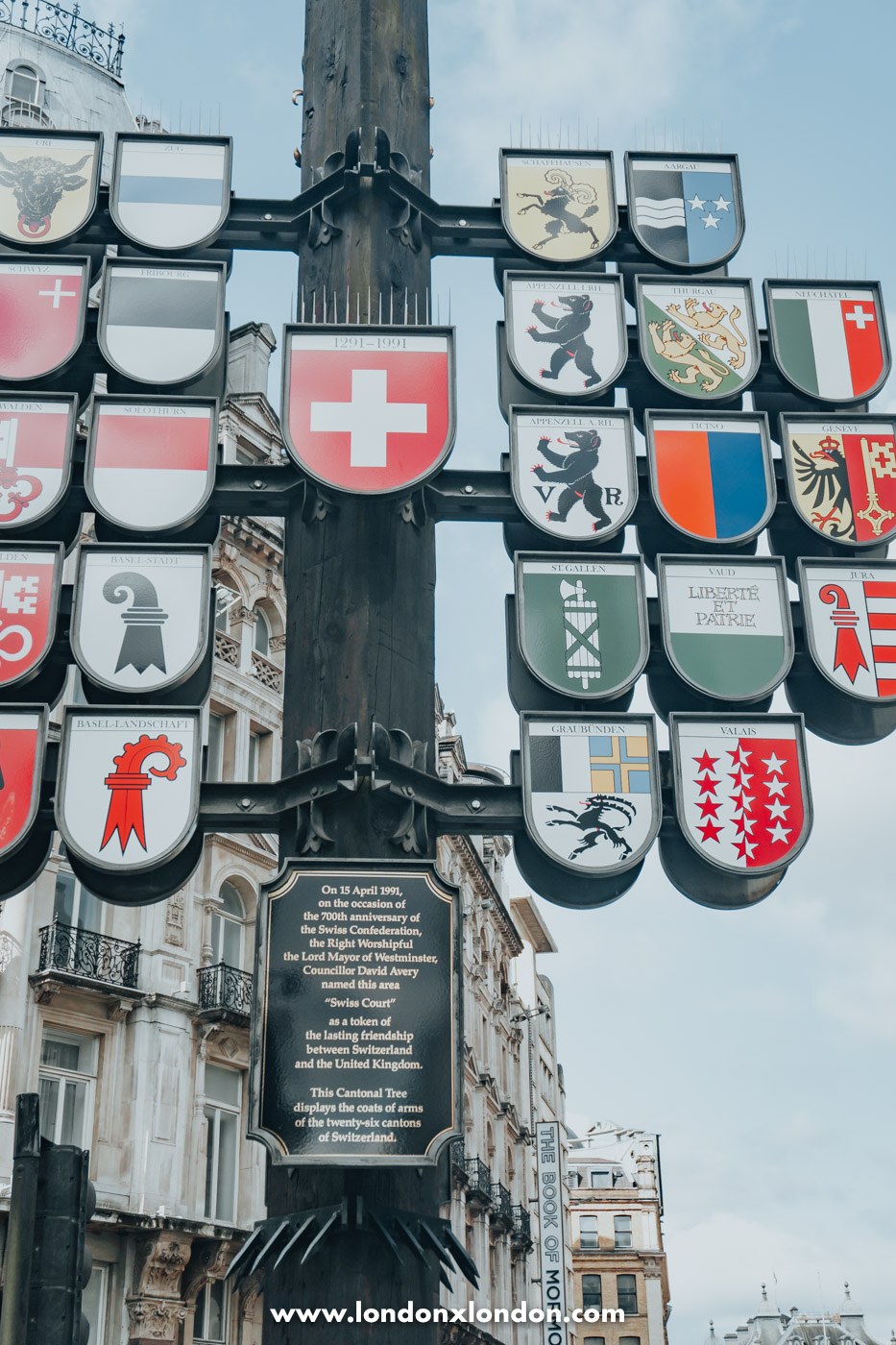
Standing a few metres away is a tall black pole hung with twenty-six shields, one for each Swiss canton. Everybody assumes it was made for the 1991 ceremony that gave the court its name. It was not.
The small brass plaque on it reads, in full, that it is an antique Swiss inn sign, given by Switzerland to Great Britain for the Silver Jubilee of Elizabeth II and presented to the Lord Mayor of Westminster by the director of the Swiss National Tourist Office in May 1977.
So it is a genuine piece of Swiss wrought ironwork that once hung outside a tavern, lifted off a Swiss street and re-erected in the middle of the West End. It still carries its gilded crown and its Krone panel, which means the inn it came from was called the Crown. A Crown sign, presented for a Queen’s Jubilee. Someone in Zurich was enjoying themselves.
The cantonal shields belong to the later dressing: the central shield is dated 1291 to 1991, and the second plaque records that on 15 April 1991, on the 700th anniversary of the Swiss Confederation, the Lord Mayor of Westminster named this area Swiss Court. All twenty-six cantons are there, Jura included, which is worth noting because Jura did not exist as a canton until 1979, two years after the sign arrived.
What was here before
The Swiss Centre was built between 1963 and 1966 and opened in 1968: a bank, a tourist office, a chocolate shop, a Swissair ticket office and a clutch of Swiss restaurants in the basement. By the late nineties the units were emptying and British souvenir stalls had moved in. Westminster concluded in 2002 that the building was not working, and it came down six years later.
What replaced it tells you something about the last twenty years of the West End. The Leicester Square frontage is now M&M’s World. The upper floors are a hotel with its entrance round on Wardour Street. A Swiss cultural showcase was swapped for an American sweet shop, and the only bits of Switzerland left on the site are the two objects standing outside on the paving.
The glockenspiel came back because its return was written into the redevelopment as a planning condition, at least according to the firm that rebuilt it. Three years in storage, then back up on its own legs.
Making a visit of it
- Where: Swiss Court, London W1D, at the Leicester Square end of Coventry Street, roughly 300 metres from Piccadilly Circus
- Nearest tube: Leicester Square is closest, Piccadilly Circus is a three-minute walk
- Cost: free, and it is on open pavement
- Allow: ten minutes, or five if you time it badly
Aim for a noon or 5pm slot and build it into something else. Our guide to Leicester Square starts about ninety seconds away, and Chinatown is on the other side of the square if you want to eat afterwards.
The London x London Take: This is one of the odder survivals in central London and it is completely free, which is not a sentence you get to write often about this postcode. Go at noon on a Saturday, stand at the north side so the figures come round towards you, and then go and read the plaque on the pole, which almost nobody does. The glockenspiel is the showpiece, but the pub sign is the better story. If you like this sort of thing, our guide to hidden gems in London and our round-up of quirky and unusual things to do in London are full of it.