
Almost every pub in London claiming to be the oldest is dating its site rather than its building, and the gap is often two hundred years. Here are 27 genuinely historic pubs with the real dates, graded by whether the inside is actually old, and an honest answer on which one wins.
Ask which is the oldest pub in London and you will get a confident answer from whichever pub you happen to be standing in. Ye Olde Mitre says 1546. The Prospect of Whitby says 1520. The Seven Stars has 1602 painted on the front.
Almost none of it survives scrutiny. The Mitre’s building is 1770s. The Prospect’s 1520 claim first appears in the 1950s. The Seven Stars was built in the 1680s. What these pubs mean is that there has been something on the site for that long, which is a different and much weaker statement.
So this guide does two things nobody else does. It gives you the documented date alongside the claimed one. And it grades every pub by CAMRA’s National Inventory of Historic Pub Interiors, which is the only objective measure of whether what you are drinking in is genuinely old or a convincing Edwardian pastiche.
Quick answers
Which is the oldest pub in London? The George in Borough has the best documented claim: it appears on a map of 1542 and the building you drink in dates from the 1677 rebuild. Historic England reached the same conclusion in 2025.
What does the CAMRA grading mean? Three stars is an interior of outstanding national importance, two is exceptional, one is significant. Eight pubs here hold three stars. It is the difference between old walls and old atmosphere.
Which has the best interior? The Black Friar, for the Grotto, or the Cittie of Yorke for the cubicles and the vats. Both three stars, both free to walk into.
Which is cheapest? Anything run by Sam Smith’s: the Cheshire Cheese, the Cittie of Yorke and the Angel. One brewery, no guest ales, and prices from another decade.
Can I walk between them? Yes, if you stay in the City. Fleet Street to Holborn gives you six of the best within fifteen minutes of each other.
So which one actually is the oldest?
The question splits three ways, and the reason nobody agrees is that people answer different versions of it.
Oldest documented trading: the George in Borough. It is on a 1542 map and named by the chronicler John Stow, which is real archival evidence rather than a brewery’s brochure.
Oldest surviving fabric: also arguably the George, whose galleried range went up in 1677. The Hoop and Grapes has a late seventeenth-century timber frame you can see warping from the pavement, though it only became a pub in 1920.
Oldest continuous site: unprovable everywhere, which is precisely why so many pubs claim it.
Our answer, and we will defend it: the George, and it is not close. If it is age you are after more broadly, our guide to the oldest buildings in London goes back a good deal further than any pub. Everything else on this list is a great pub with a shaky date.
The 27 oldest pubs in London
Ordered so the strongest claims come first and the youngest buildings last. Each one carries its documented date, its CAMRA grade where it has one, and the address, so you can build a route from it. The crawls are at the foot of the page.
Ye Olde Cheshire Cheese
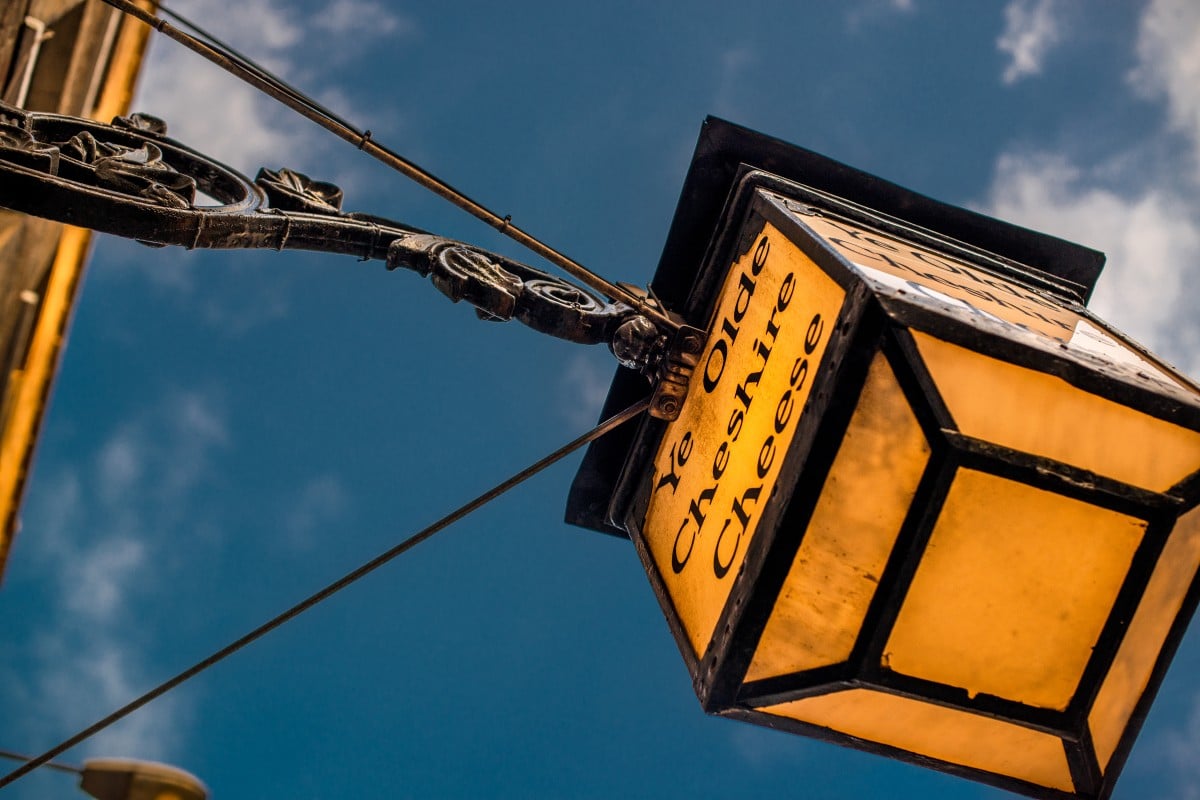
Rebuilt in 1667, the year after the Great Fire, down an alley off Fleet Street, with sawdust on the floors and thirteenth-century Carmelite cellars underneath. Dickens, Tennyson, Conan Doyle and Twain all drank here, and the literary plaque industry has never recovered.
Take the stone staircase down to the cellars, which divide into a series of small drinking spaces and are the part of the building that predates the Great Fire. Find Polly on the way: the pub parrot has been stuffed and under glass since 1926, and she used to swear at customers. Ask which bar was the gentlemen-only one, because the sign is still up. Sam Smith’s, so the pint is cheap and there is one brewery on the bar.
Where: 145 Fleet Street, EC4A 2BU. Documented 1667. CAMRA three stars. Sam Smith’s.
The George Inn
The last galleried coaching inn in London, Grade I listed, owned by the National Trust and run by Greene King. It is on a map of 1542, the current range went up in 1677 after a fire, and it is the honest answer to the oldest-pub question.
Drink in the Middle Bar, which was the Coffee Room Dickens used, then take your pint out into the yard, because the galleries only make sense from below. The food is better than a Grade I listing needs it to be and the chicken sharer is the one we keep ordering; there is a separate gluten-free menu, and for central London it is reasonably priced.
Where: 77 Borough High Street, SE1 1NH. Documented 1542, building 1677. Grade I. CAMRA three stars. National Trust, run by Greene King.
Ye Olde Wine Shades
Built in 1663 and the strongest surviving-the-Fire claim in the City, which is unusual on a list where most such claims collapse. Now run by Davy’s as a wine bar rather than a pub, with the original panelling and a smuggling tunnel entrance still visible.
This is the one to pick if you want the seventeenth century without the crowd. It is a wine list rather than a beer list, so go for a glass and the room rather than a pint. Closed at weekends.
Where: 6 Martin Lane, EC4R 0DP. Built 1663. Grade II. Davy’s.
Hoop and Grapes
The warped timber frame on Aldgate High Street is late seventeenth century and genuinely leaning, which makes it one of the oldest surviving buildings in the City.
Look at the two carved posts either side of the door, then be clear about what you are drinking in. The building is old and it only became a pub in 1920, so the “oldest licensed house in the City” line you will see quoted does not hold. Go for the frame, not the claim.
Where: 47 Aldgate High Street, EC3N 1AL. Building late C17, pub from 1920. Grade II*. Nicholson’s.
Cittie of Yorke
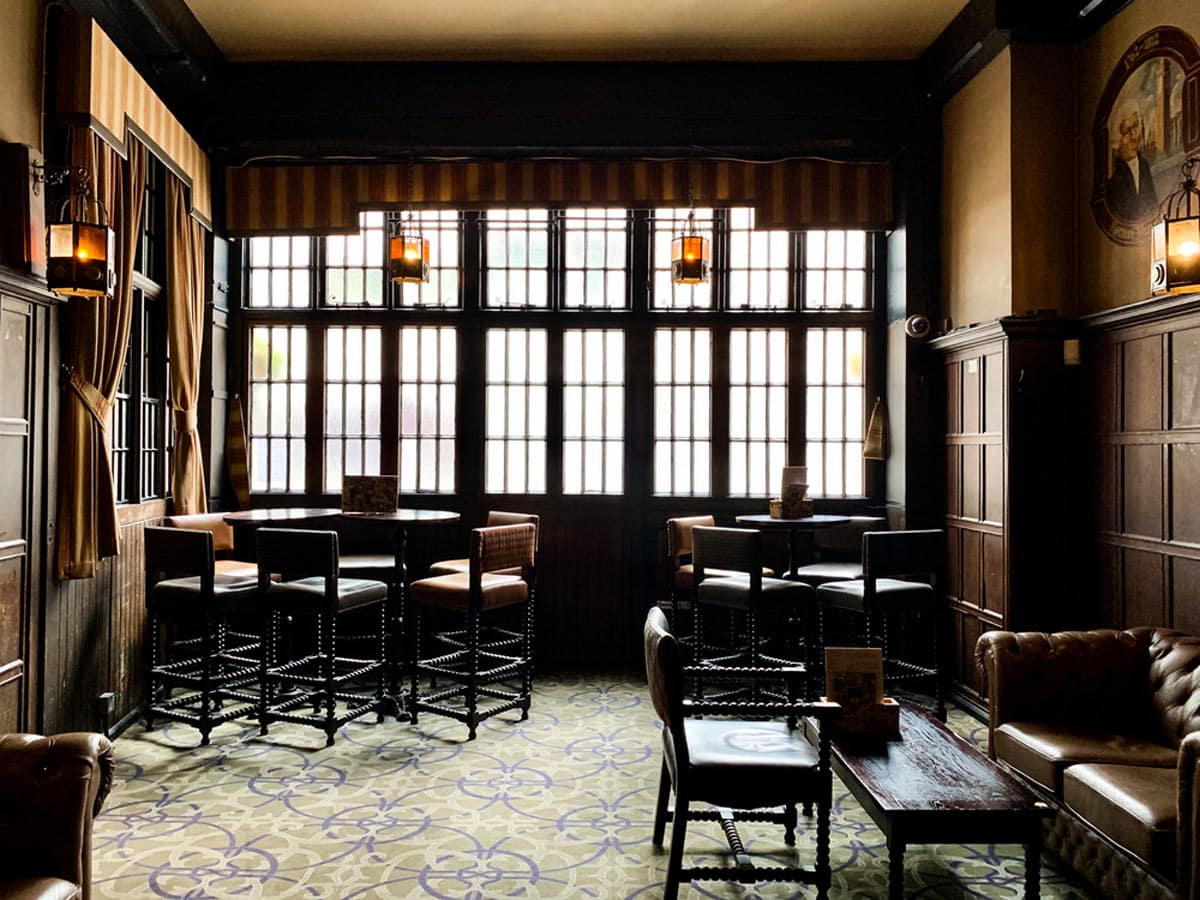
There has been a drinking house here since about 1430 and the building is a 1923 reconstruction, which sounds like a disappointment and is not: the back bar is one of the great rooms in London, with a hundred-foot ceiling, a row of enormous wine vats on cast-iron columns and ten wooden cubicles down one side.
Get a cubicle, find the triangular stove, and then go down to the basement if it is open, because it has a bar of its own. We would not send anyone claustrophobic down there. You come in through a passage, past a wooden bar, and only then into the main chamber, which is why people walk in and think the pub is small. The stove in the middle of the big room is around 1815, has no visible chimney and is said to have come from Gray’s Inn. Sam Smith’s prices, and it shuts at six on Sundays.
Where: 22 High Holborn, WC1V 6BN. Site from c.1430, building 1923. CAMRA three stars. Sam Smith’s.
The Seven Stars
Behind the Royal Courts of Justice, run by Roxy Beaujolais as a free house, and full of barristers doing exactly what you would hope after a verdict.
Sit in the Wig Box, the snug next door, and look at the etched doors. They read “private counter” and “general counter”, wording that may be unique in London. The frontage says 1602 and historians date the building to the 1680s, so treat the sign as decoration. There is usually a cat in a ruff.
Where: 51-54 Carey Street, WC2A 2JB. Built 1680s. Free house.
The Old Bell Tavern
Established 1678, on a Fleet Street site where Wynkyn de Worde set up the street’s first printing press around 1500. It was the Golden Bell and then the Twelve Bells before it settled.
Take the back door out into St Bride’s churchyard, which almost nobody does. You will see the tradition repeated that Wren built the pub for his masons rebuilding St Bride’s; there is no documentation for it and the dates do not quite work, so enjoy it as a story. The stained glass at the front is the real draw.
Where: 95 Fleet Street, EC4Y 1DH. Established 1678. Nicholson’s.
Ye Olde Mitre
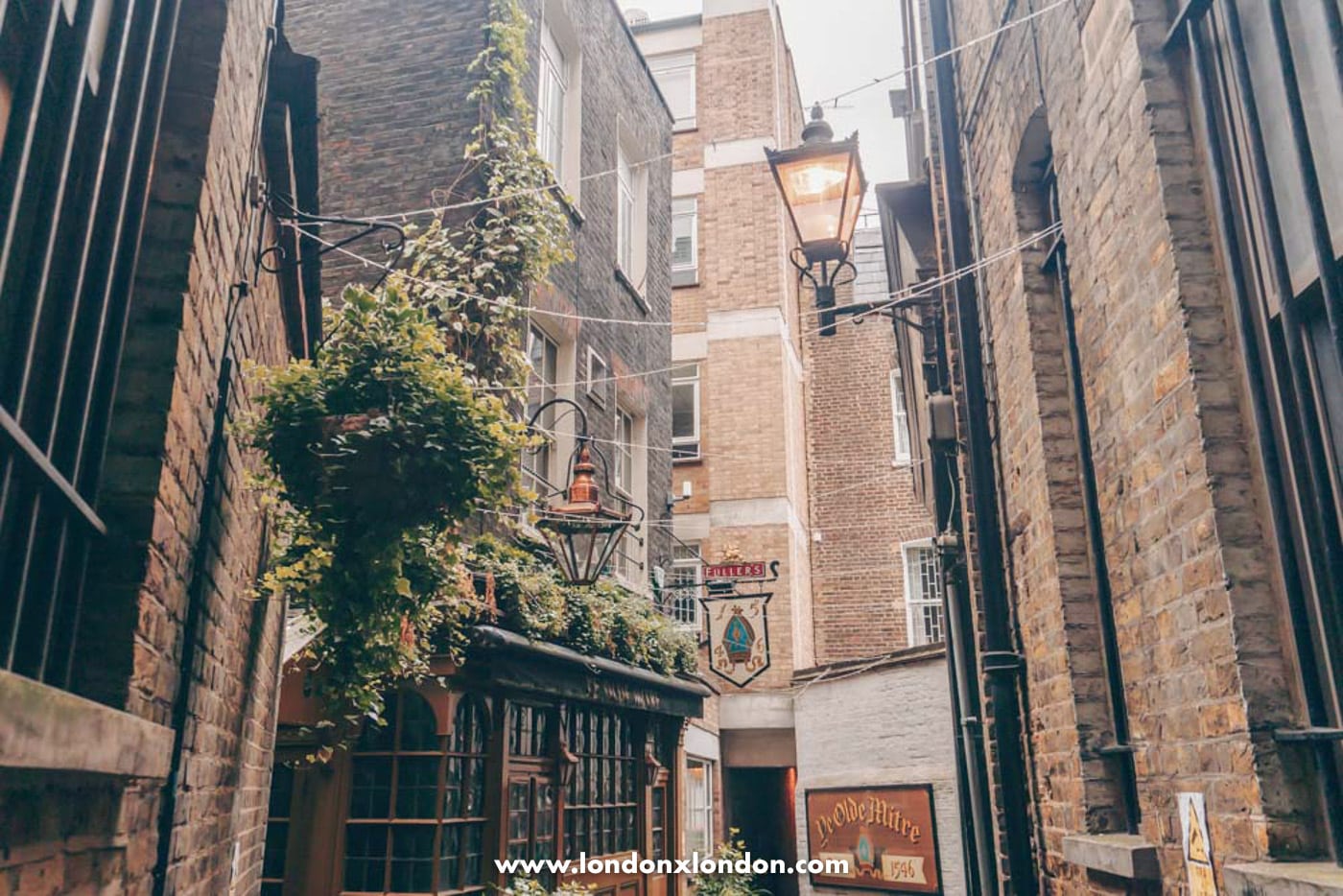
Down an alley off Hatton Garden so narrow you will walk past it twice. We have a piece on Ye Olde Mitre on its own. A tavern was built here in 1546 for the Bishop of Ely’s servants and the standing building is around 1773, with a 1920s refit.
Order the scotch eggs and do not arrive starving, because the kitchen is too small for a full menu. There are three small rooms, seven real ales on at any time and a proper scrumpy, and the wine is better than it needs to be. Go at night, when the little courtyard is strung with fairy lights, and check before you make a special trip because it closes at least one day most weekends. Regulars will still tell you Ely Place is technically Cambridgeshire. Find the cherry tree trunk preserved in the panelling of the front bar, which marks the old boundary between the Bishop of Ely’s land and Sir Christopher Hatton’s, and which Elizabeth I is supposed to have danced round. It is our favourite pub in Farringdon and, on a good night, our favourite in London.
Where: 1 Ely Court, Ely Place, EC1N 6SJ. Tavern 1546, building c.1773. CAMRA two stars. Fuller’s.
Hand and Shears
A small Grade II pub in Smithfield, named for the shears that were used to open Bartholomew Fair from the twelfth century until 1855. The interior is a rare surviving four-bar layout.
Go for the layout, which is the point of it. Four separate drinking spaces off a central servery, almost unaltered, and the sort of thing CAMRA gives three stars to precisely because so few survive. It is two minutes from Smithfield, so pair it with the market before the London Museum opens there in November.
Where: 1 Middle Street, EC1A 7JA. CAMRA three stars.
Jamaica Wine House
Down St Michael’s Alley on the site of the Pasqua Rosee’s Head, which opened in 1652 as London’s first coffee house. The current building is Victorian and the alley is unchanged.
Come at lunchtime on a weekday and go downstairs to the Todd’s wine bar. The ground floor is a City drinking room that empties at seven and closes at weekends, so this is a Tuesday pub rather than a Saturday one. The plaque outside marks where London started drinking coffee, which is a better claim than most pubs on this list can manage.
Where: St Michael’s Alley, EC3V 9DS. Coffee house 1652, building Victorian. CAMRA three stars.
The Mayflower
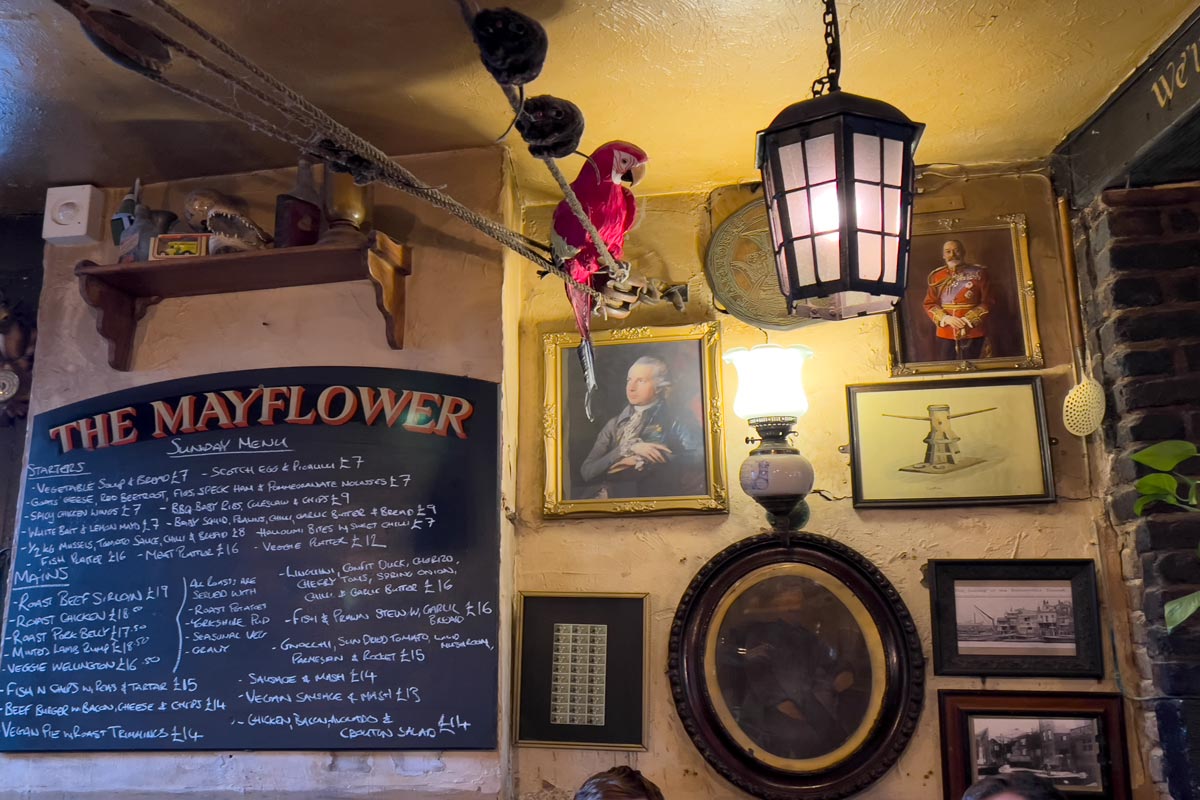
On the Rotherhithe waterfront, where the Mayflower moored before sailing for Plymouth and then America in 1620. The building is 1780s, which is rather later than the story implies.
Sit at the outside tables on the decked jetty, which are the whole point and the best place in Rotherhithe to spend an afternoon. If you only do one waterside pub down here, do this one. Go at low tide and you can see the mooring the ship used, which is the only history on this list still sitting in the water. Inside is a black timber bar and a great deal of antique clutter, with a restaurant upstairs doing Sunday roasts and beer-battered fish.
Where: 117 Rotherhithe Street, SE16 4NF. Mooring 1620, building 1780s. CAMRA two stars.
The Angel
A Sam Smith’s pub on Bermondsey Wall with a balcony that hangs directly over the Thames, on a site with a seventeenth-century predecessor and a building from the 1830s.
Get out onto the narrow balcony, which is where the view is, and go for sunset. It is covered, so it works in the rain. Upstairs is a bigger dining room than the compact bar downstairs, and Tower Bridge is straight down the river from either. The Steak and Old Brewery Bitter pie and the hand-battered fish and chips are the orders; the rest of the menu feels as though it has not changed since about 1985, which is either the charm or the problem. Sam Smith’s prices, and no real ale at all.
Where: 101 Bermondsey Wall East, SE16 4NB. Building 1830s. Grade II. Sam Smith’s.
George and Vulture
A chophouse in a courtyard off Cornhill, and the pub Dickens actually used: it appears more than twenty times in The Pickwick Papers, which is more than any other building in the book.
Book a table and order a chop, because this is a lunch operation rather than a drinking one. Weekdays only, and the Pickwick Club still holds dinners here, which is the sort of thing that would be invented if it were not true.
Where: 3 Castle Court, EC3V 9DL. CAMRA two stars.
Lamb and Flag

A Covent Garden alley pub first licensed in 1772 as the Cooper’s Arms, with late seventeenth-century fabric behind an interior that has kept its curved panelled counter and settles.
Go upstairs to the Dryden Room, which most drinkers never find. The upstairs room hosted bare-knuckle fights, which is where the Bucket of Blood nickname comes from. The poet John Dryden was beaten in Rose Alley outside in 1679 and, despite what you will read everywhere, nobody was ever identified. It has been open more than 240 years and it is still one of the best pubs in Covent Garden, which is a crowded field. More of the area in our Covent Garden guide.
Where: 33 Rose Street, WC2E 9EB. Licensed 1772. CAMRA three stars. Fuller’s.
The Town of Ramsgate
A narrow Wapping pub named for the Kent fishermen who landed their catch here because the taxes were lighter. The building is 1758 on earlier foundations and the interior has barely changed since the 1930s.
Take your drink down Wapping Old Stairs, because one wall of the alley is the wall of the pub. We rate the stairs on their own and the two together make the trip worth it. The cellar underneath you held prisoners waiting to be shipped to Australia, and the hanging judge Jeffreys was caught on these steps trying to flee the country. Almost everyone drinks here without going down them.
Where: 62 Wapping High Street, E1W 2PN. Building 1758. CAMRA one star. Independent.
The Grapes
A Limehouse pub owned by Ian McKellen, Sean Mathias and Evgeny Lebedev, with an origin around 1583 and a structure from the 1720s. Dickens opens Our Mutual Friend in it.
Look behind the bar for Gandalf’s staff, then go out the back. Inside is small and properly gloomy, all dark wood and deep reds, and it feels every bit as old as it is. McKellen used to run the Monday quiz before stepping back. Out on the little deck you are looking at Antony Gormley’s Another Time standing in the river, visible only at certain tides.
Where: 76 Narrow Street, E14 8BP. Structure 1720s. CAMRA one star.
The Dove
An early eighteenth-century riverside pub in Hammersmith, Grade II listed, where Rule Britannia was reportedly written and Hemingway and Graham Greene both drank.
Try for the front snug, the smallest public bar in Britain at 33 square feet, which holds about four people. There is no strategy beyond arriving before six. The terrace over the Thames is the consolation prize and it is a good one, particularly through the Boat Race.
Where: 19 Upper Mall, W6 9TA. Early C18. Grade II. CAMRA three stars. Fuller’s.
The Prospect of Whitby
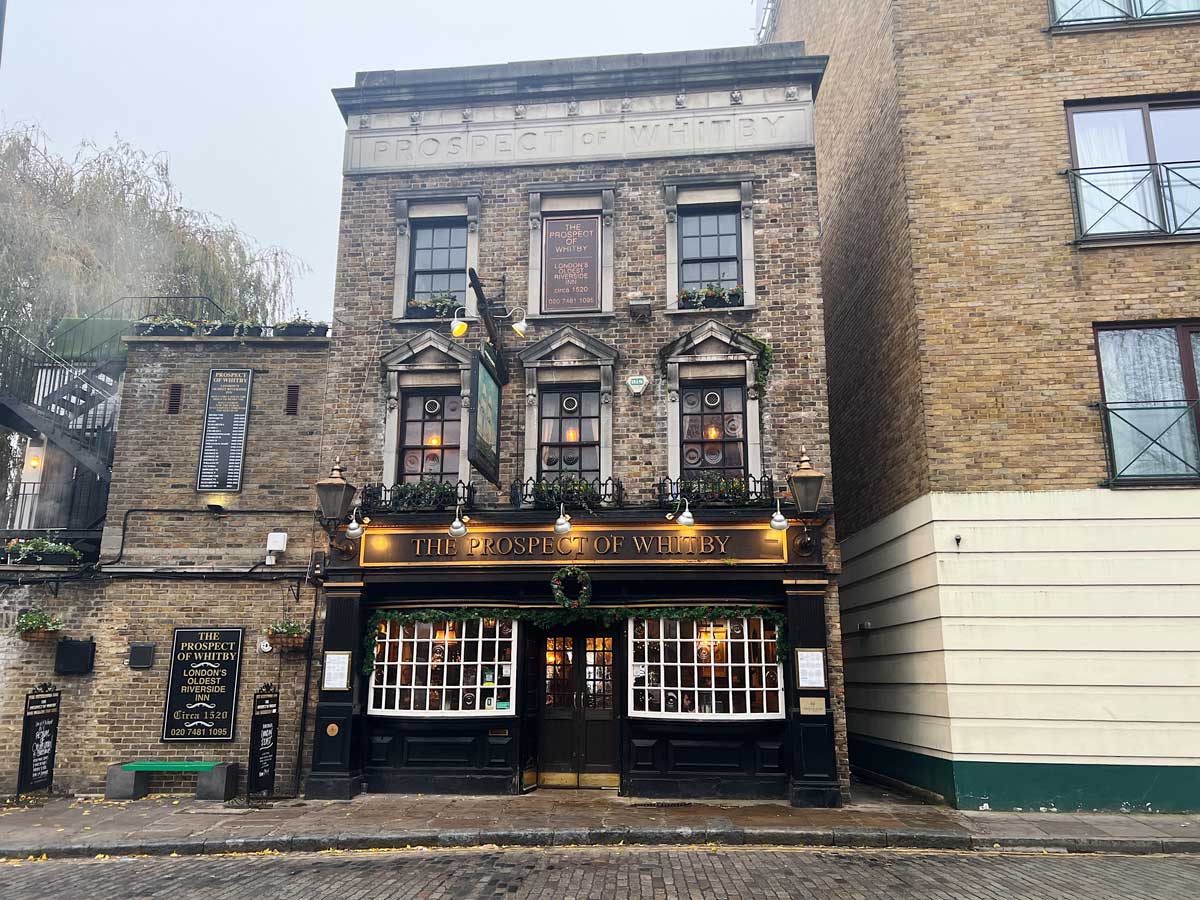
The Wapping riverside pub that everyone sends you to, once the Devil’s Tavern, with a pewter-topped bar and a stone floor said to be four hundred years old.
Sit in the riverside beer garden, from where you can see the replica noose hanging over the water. Know what you are getting, though: the 1520 date first appears in the 1950s and looks like marketing, the front was refaced in the early nineteenth century, and it is not on CAMRA’s inventory at all because the interior is not intact. It is still one of the best places in Wapping to drink by the river, which is a different compliment.
Where: 57 Wapping Wall, E1W 3SH. 1520 claim unsupported. Not on the CAMRA inventory. Greene King.
The Black Friar
Built in 1871 and then remade around 1905 by H. Fuller-Clark with the sculptors Henry Poole and Frederick Callcott, into the strangest pub interior in London: marble, mosaic, bronze reliefs and friars everywhere.
Go through to the Grotto and look up. The barrel-vaulted back room was added between 1917 and 1921 and the alabaster capitals carry nursery rhymes and Aesop’s fables. It is table service only in there, which keeps it calm. It was going to be demolished in the sixties until John Betjeman got involved, which is the fact worth knowing.
Where: 174 Queen Victoria Street, EC4V 4EG. Built 1871, interior c.1905. Grade II*. CAMRA three stars. Nicholson’s.
The Viaduct Tavern
An 1874 gin palace opposite the Old Bailey, with an interior from around 1900: etched glass, a cashier’s booth and three Pre-Raphaelite-style paintings set into marble architraves.
Ask to see the cellars when it is quiet. There are cells down there, said to be remains of Newgate Prison. The staff will usually take you if you catch them mid-afternoon rather than at six, and it is free.
Where: 126 Newgate Street, EC1A 7AA. Built 1874. CAMRA three stars. Fuller’s.
The French House
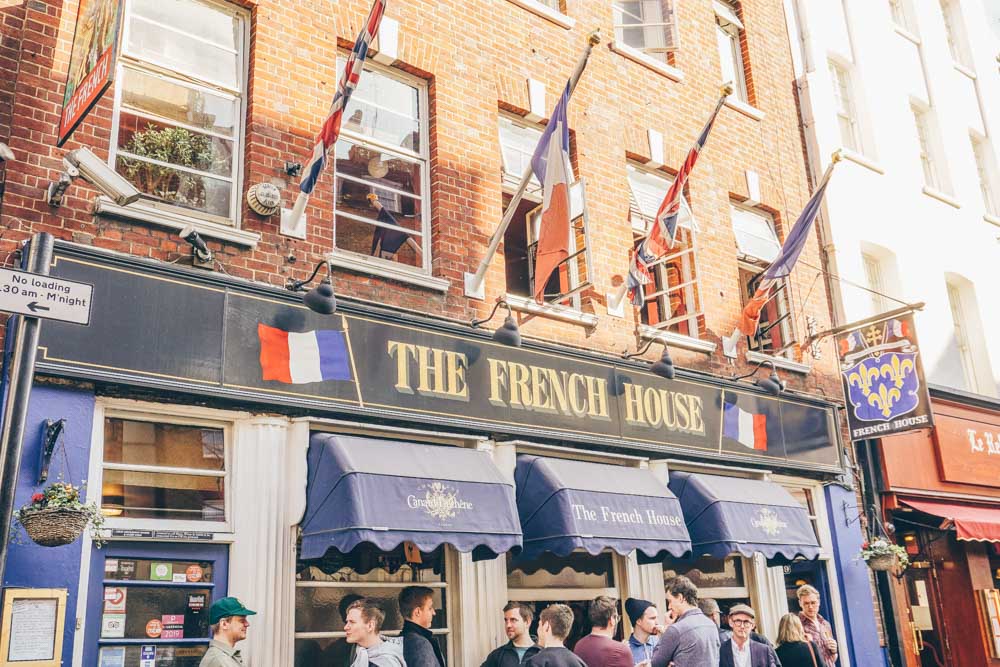
Opened in 1891 as the York Minster and renamed in 1984, after the cathedral fire in York sent a wave of misdirected condolences and deliveries to Dean Street. De Gaulle drank here. So did Bacon, Freud and most of literary Soho.
Order a half, because that is all they serve, every day except 1 April. No music, no machines, no television and no phones. It sells more Ricard than anywhere else in Britain, which tells you what to drink. More of the area in our Soho guide.
Where: 49 Dean Street, W1D 5BG. Opened 1891. CAMRA two stars.
The Guinea
A Mayfair mews pub rebuilt in 1741 and licensed in 1754, run by Young’s since 1888, with a rare Victorian low screen and working door still in place at the bar.
Eat here rather than just drinking: the Grill Room behind the bar has been going since 1952 and does some of the best steaks in the country. Pick your own cut from the display fridge. The wine list runs from a house red, white or sherry at three quid a glass to a bottle of Chateau Latour at £2,450.50, so you can spend whatever you like. The pub is not a listed building despite everything it claims about 1423, and the steak is genuinely very good, so let the food carry it.
Where: 30 Bruton Place, W1J 6NL. Rebuilt 1741. CAMRA three stars. Young’s.
The Grenadier
A Belgravia backstreet pub with a ceiling covered in banknotes, stapled up by customers to pay off the gambling debt of a soldier called Cedric who is said to haunt it.
Add a note to the ceiling, and take the history with salt. The banknotes are real and the stories are not: CAMRA dates the building to 1843, records it as the New Grenadier until 1885, and finds no evidence of 1720, an officers’ mess or the Duke of Wellington. It was bought by INEOS in 2022. There is a notice outside limiting service to people arriving on foot or by taxi.
Where: 18 Wilton Row, SW1X 7NR. Built 1843. CAMRA two stars. INEOS.
The Nag’s Head
An early Victorian mews pub in Belgravia, a free house since 1991, and about the size of a front room.
Go to the upper bar for the lowest bar counter in London, with its Victorian pewter beer engine still on it, and leave your phone in your pocket. Kevin the landlord is warm, welcoming and very charismatic, and he is also entirely serious about the rules: taking a phone out gets you stern words, and so does sitting at a table bigger than your party needs. The room is pokey enough that you end up crammed in among the cartoons, garden tools and vintage penny slots, which is the appeal. Time it right and there is live jazz.
Where: 53 Kinnerton Street, SW1X 8ED. Early Victorian. Free house.
The Cross Keys
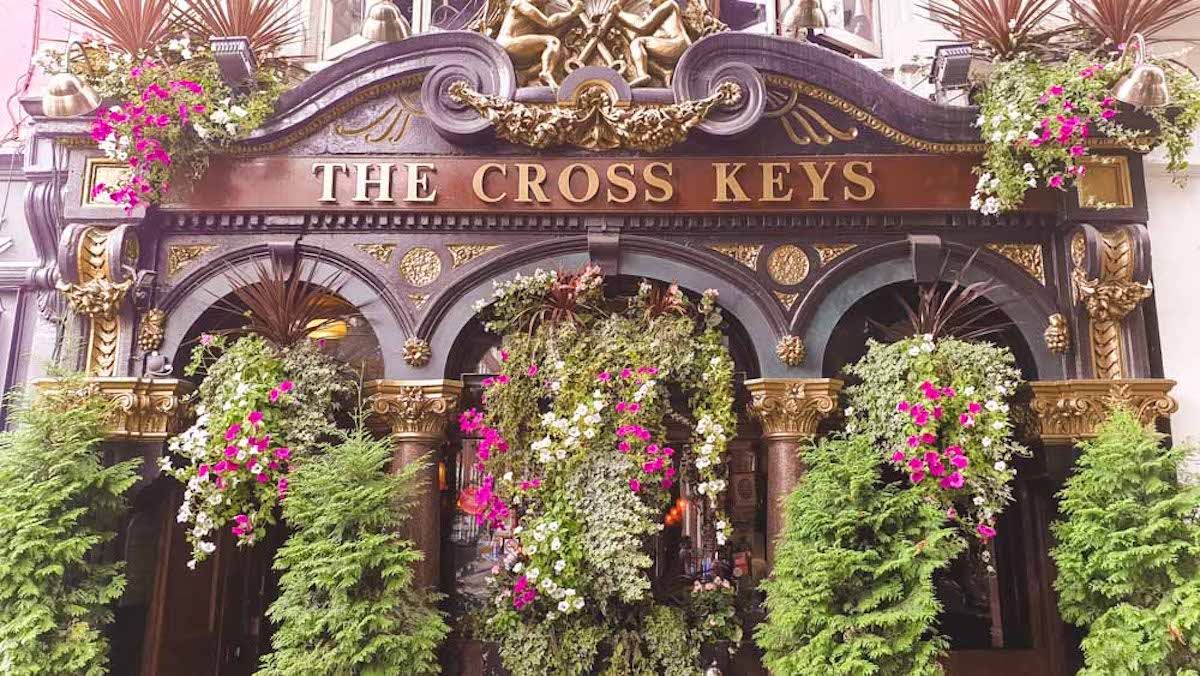
Built in 1848 and buried under so many hanging baskets that finding the door is a genuine task. Inside is a Victorian bar-back in four carved bays, and a collection of bric-a-brac including a diving helmet.
Come for the frontage in summer, and go inside for the craft beer, which is about the best selection in Covent Garden. It is dark in there and that only helps, with Victoriana and eclectic paintings over every wall. It has barely changed in decades. Do not come for the age, though: it is the youngest pub on this list by some distance, and it is here because the interior is intact and the flowers are ridiculous. Fair warning that they show a full calendar of sport, so you can walk in mid-game to a room of packed punters.
Where: 31 Endell Street, WC2H 9BA. Built 1848. Independent.
The Spaniards Inn
A 1585 tollgate building on the edge of Hampstead Heath, low-beamed and dark, with a garden that fills the moment the sun appears.
Order the handmade scotch egg, which is worth coming for on its own, and ask what is on the taps rather than assuming. The limited-edition beers sell through fast. Look across the road at the 1710 toll house, still standing with traffic squeezing past either side of it. You will read that Keats wrote Ode to a Nightingale here; the first-hand account from Charles Brown puts it under a plum tree at his house on Keats Grove, so enjoy the garden without the attribution. Pair it with one of our Hampstead Heath walks.
Where: Spaniards Road, NW3 7JJ. Building 1585. CAMRA one star.
The Wrestlers
A Highgate pub on a site going back to 1547, in a building rebuilt in 1921, run by London Village Inns since 1997.
Look above the fireplace for the horns, then ask when the next Swearing on the Horns is. The ceremony involves taking an oath to merriment under a pair of antlers and it has run in Highgate for centuries. It has no fixed calendar now, so the pub asks you to get in touch, which is worth doing rather than turning up hopefully.
Where: 98 North Road, N6 4AA. Site 1547, building 1921. CAMRA one star.
One to cross off
The Tipperary on Fleet Street has been closed since December 2024, with the pub and the adjoining site under redevelopment and a reopening targeted for 2027. It had only reopened that March. This one matters more than most closures on a list like this, because its interior holds three CAMRA stars, so it is the biggest heritage risk among London’s historic pubs right now. Its claim to be London’s oldest Irish pub is trade tradition rather than record, incidentally.
Making a crawl of it
The City gives you the best run. Start at the Cheshire Cheese on Fleet Street, walk to the Old Bell, then the Black Friar, then up to the Viaduct Tavern, across to the Cittie of Yorke and finish at Ye Olde Mitre. Six pubs, four of them three-star interiors, and about fifteen minutes of walking in total.
Do it on a weekday and start at five. Half of these are City pubs that close at weekends entirely, and the other half are empty by eight on a Friday because everyone has gone home. A Tuesday evening is the sweet spot, and the Cheshire Cheese and Cittie of Yorke are both Sam Smith’s, so two of your six rounds come in cheap.
For the riverside version, Wapping to Limehouse gives you the Town of Ramsgate, the Prospect of Whitby and the Grapes along the Thames Path in about forty minutes.
The London x London Take: The dates on these pubs are mostly nonsense and it does not matter nearly as much as you would think. What you actually want from an old pub is not a founding year, it is an interior nobody has been allowed to rip out, and that is exactly what CAMRA’s inventory measures. Go to the three-star ones. The Black Friar’s Grotto, the back bar of the Cittie of Yorke, the four rooms of the Hand and Shears and the George’s galleries are the four genuinely remarkable pub interiors in this city, and not one of them charges you a penny to stand in it. The Prospect of Whitby, meanwhile, is on every list including ours and is not on the inventory at all, which tells you something about how these lists get written.
Dickens makes another appearance here, as The Grapes is supposedly the pub described in the opening of
Oh really! I’ll have to have a read again, there are so many Dickens spots in London.