Devonshire House is such a hidden secret in London’s West End that it no longer exists. Yet the legacy of the Duke of Devonshire’s London pad remains.
From fire damage to becoming one of London’s finest mansions, to its eventual demolition and replacement by offices, the history of Devonshire House is enormously rich.
Two hundred years at the heart of London’s social life scene provides plenty of stories and an impressive cast of characters, from politicians to royalty.
So, pull up a pew as we venture down Memory Lane (or, more accurately, Piccadilly) and discover the hidden secrets of Devonshire House.
The history of Devonshire House
Ready to nerd out? Let’s take a look at the history behind this very famous house, which involves three separate Dukes of Devonshire across a century and a half, not one.
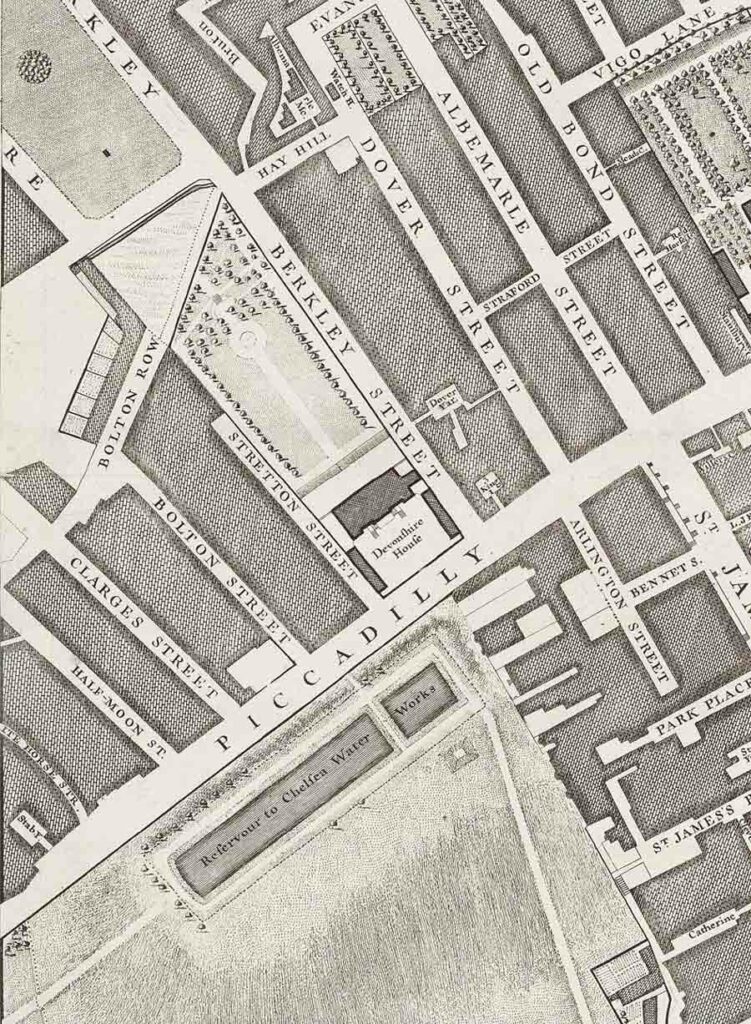
Devonshire House came into being in 1696 when William Cavendish, the 1st Duke of Devonshire, purchased Berkeley House, built between 1665 and 1673. In true Duke fashion, he changed the name in his own honour.
The house, on the site of what’s now the north-east corner of Green Park, was destroyed on 16th October 1733 by fire, despite the firefighting efforts of the Regiment of Guards, led by Willem van Keppel, 2nd Earl of Albemarle, alongside local troops led by the Prince of Wales.
The house was undergoing refurbishment at the time, and (surprise, surprise) the finger of blame was pointed squarely at careless labourers.
The second Devonshire House
In a twist of fate, the fire occurred just as London society was undergoing a shift in social events, with large gatherings consisting of dance, wine and merriment becoming the norm.
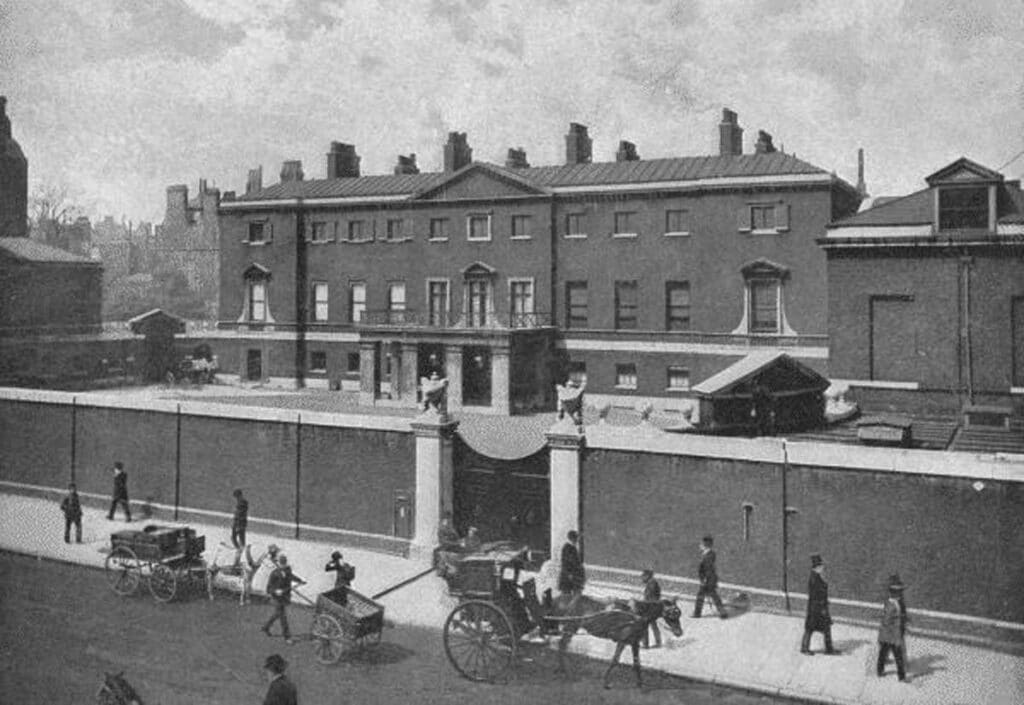
It fell to the 3rd Duke, decades after the 1st Duke had first bought and named the house, to seize the opportunity and rebuild Devonshire House as a vast, majestic palace fit for hosting balls and concerts. He commissioned William Kent to design the palace, Kent’s first commission for a London house, at a cost of around £20,000, plus a further £1,000 paid to Kent personally.
He created a sprawling house over three storeys in eleven bays, in a design described as “severe” despite its Palladian style. The building of the palace took around six years and finished in 1740.
Indeed, the stark interior gave little hint as to the riches contained inside, with the Devonshire art collection, one of the finest in England in the 18th century, housed within.
Oh, and a 40-foot-long library that, among other treasures, contained Claude Lorraine’s Liber Veritatis, the artist’s complete record of sketches.
Ironically, the family’s earlier London home, Old Devonshire House in Bloomsbury, sold off by this point but still standing, would go on to outlast the grand Piccadilly palace by nearly two decades, before finally being destroyed by a Luftwaffe bomb during the Blitz in 1941.
Alterations and the Victorian age
During the late 1700s, James Wyatt made alterations to the palace before Decimus Burton created a new portico, grand staircase and opulent entrance hall for the 6th Duke of Devonshire in 1843.
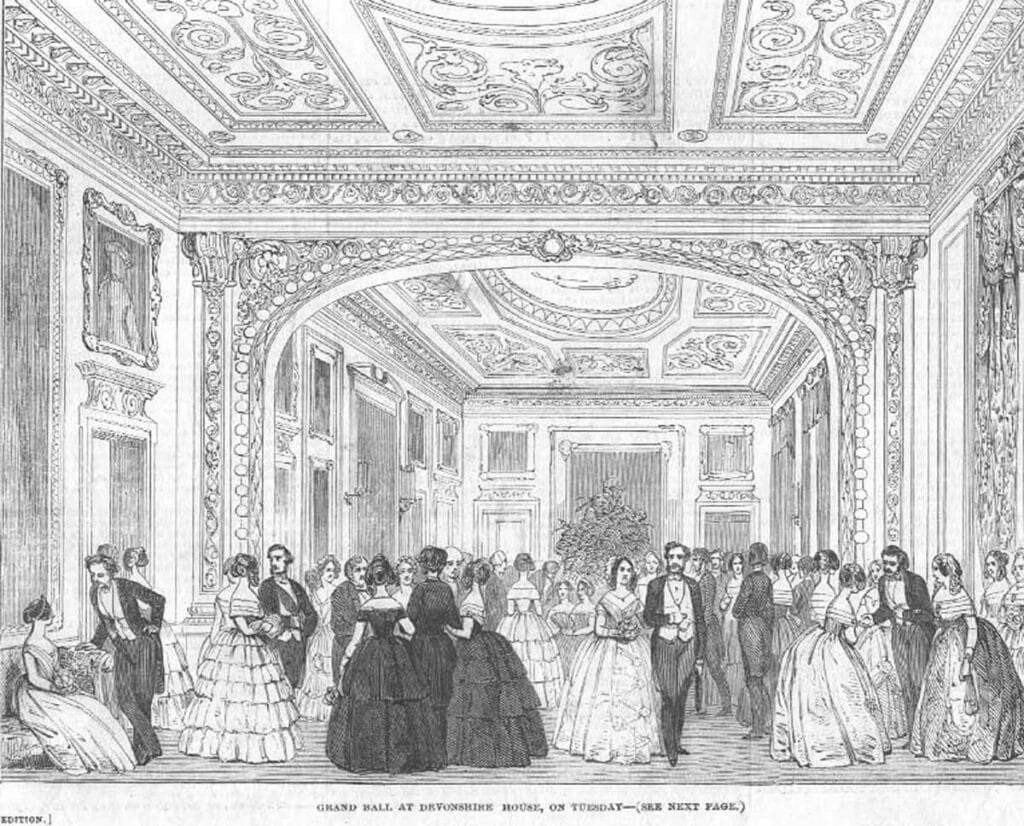
By this point, Devonshire House was one of London’s prime social hotspots, with people flocking to see the “Crystal Staircase” in particular, formed of newel posts and a crystal glass bannister. The 6th Duke, a close friend of the Prince Regent, hosted the King of Prussia and the Russian Tsar in the ballroom, fitting company for a man later appointed ambassador extraordinary to the Russian Empire for Tsar Nicholas I’s coronation.
The 5th Duke, William Cavendish, was a Whig supporter of Charles James Fox, and Devonshire House became the setting for the remarkable social and political life of Cavendish’s circle of noble and political friends. Such was the grandiosity of the palace that it became an entertainment centre for social events rather than a place to live.
In 1897, the house hosted the Diamond Jubilee of Queen Victoria with a lavish fancy dress ball, the Devonshire House Ball of 1897.
All the guests, including the Prince and Princess of Wales, dressed as historical portraits. Many photos of the event became well-known fixtures in the late Victorian era history books.
World War I and demolition
The British Red Cross used Devonshire House during World War I as a postal sorting office. Eventually, the aeronautical pioneer Gertrude Bacon took charge of the office as part of her service, which saw her awarded the British War Medal.
At the end of the war, the 9th Duke of Devonshire faced death duties above £500,000, on top of significant debts inherited from the 7th Duke, prompting the sale of many family heirlooms.
Among the treasures sold were several books printed by William Caxton, first editions of Shakespeare, and eventually Devonshire House itself, along with its three acres of gardens.
The house fetched a whopping £750,000, and the purchasers, Shurmer Sibthorpe and Lawrence Harrison, decided to demolish the building. It came down in 1924.
Virginia Woolf mentions the demolition when her famous Mrs Clarissa Dalloway describes “Devonshire House without its gilt leopards” as she walks along Piccadilly, while war poet Siegfried Sassoon described the demolition itself in his “Monody on the Demolition of Devonshire House”.
Devonshire House today
A new office block, designed by Carrère and Hastings, was built on the site in 1926, leading directly onto Piccadilly and taking its name from the house it replaced. It’s Grade II* listed. The building became the UK headquarters of Citroën until 1936, later served as the War Damage Commission’s headquarters during the Second World War, and was later still home to the Rootes Group and a Rover car showroom, before settling into life as office space.
Parts of Devonshire House are still visible today, with some artworks and furniture installed at Chatsworth House. The famous iron entrance gates, the absence of which Mrs Dalloway bemoans, now stand on the other side of Piccadilly to form one of the entrances to Green Park, Grade II* listed in their own right since 1970.
Meanwhile, the wine cellar of Devonshire House is now the ticket office of Green Park Underground station. Sadly, no bottles remain for travellers to enjoy.
The London x London Take: The best part of this story isn’t the palace itself, it’s that three different Dukes across a century and a half kept reshaping the same plot of land, each leaving a mark that outlasted the last: a name from the 1st Duke, a Kent-designed palace from the 3rd, a ballroom fit for tsars from the 6th. Look for the gates at Green Park next time you’re passing, then head into the tube station itself, you’re standing in what used to be the wine cellar of one of London’s grandest addresses.
Practical information
- What little of Devonshire House remains can be seen by visiting Green Park Underground station and enjoyed as you walk through the ticket hall and along the south side of Piccadilly to where the wrought-iron gates stand.
- The current Devonshire House building sits across the road from the entrance of Green Park on Piccadilly. It’s worth checking current ground-floor occupants before visiting if you’re planning around a specific shop, these do change.
Address: Piccadilly, SW1
More Hidden London guides
- Piccadilly Circus: London’s Cool Neon Hub
- Fire of London Facts We Bet You Didn’t Know
- Time to Discover: The Tower of London