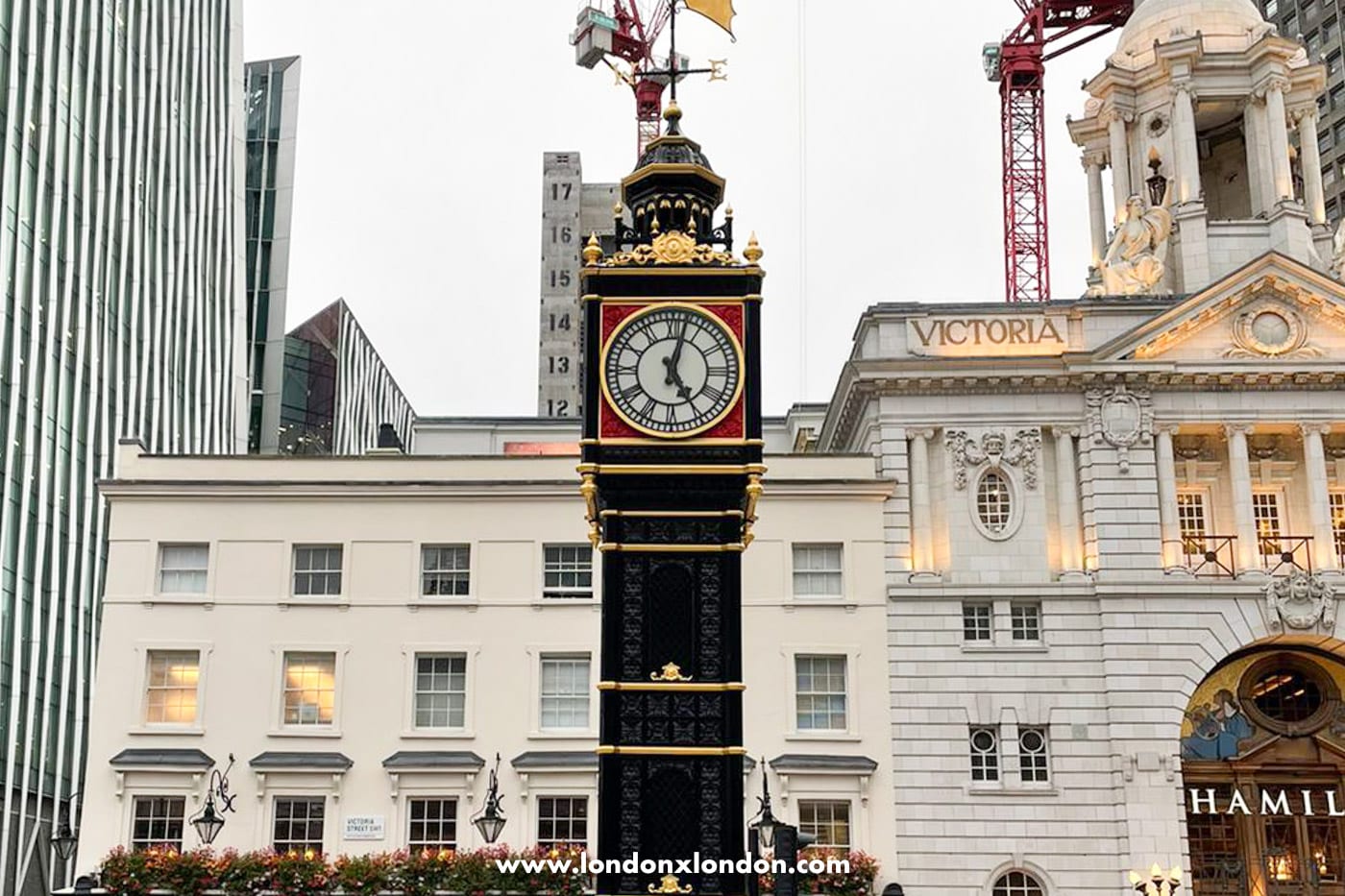
You’ve probably heard of Big Ben. But have you ever stumbled across his considerably smaller, slightly gothier sibling outside Victoria Station?
We’ll be honest: we’d walked past Little Ben dozens of times before one day we did a genuine double-take and thought, hang on, that clock looks a little bit too familiar.
Situated outside Victoria Station at the junction of Vauxhall Bridge Road and Victoria Street, Little Ben stands just over 20 feet tall, decorated in black, gold and red, adorned with ornate Victorian ironwork and topped with a gilded dome. It’s not identical to Big Ben, despite what the name implies: where its famous sibling is all perpendicular Gothic grandeur, Little Ben is more decorative, more flamboyant, with black roses on its panels and, if you look carefully at the gilt work, a small representation of Father Time on each side. Different personalities, same family.
The history of Little Ben
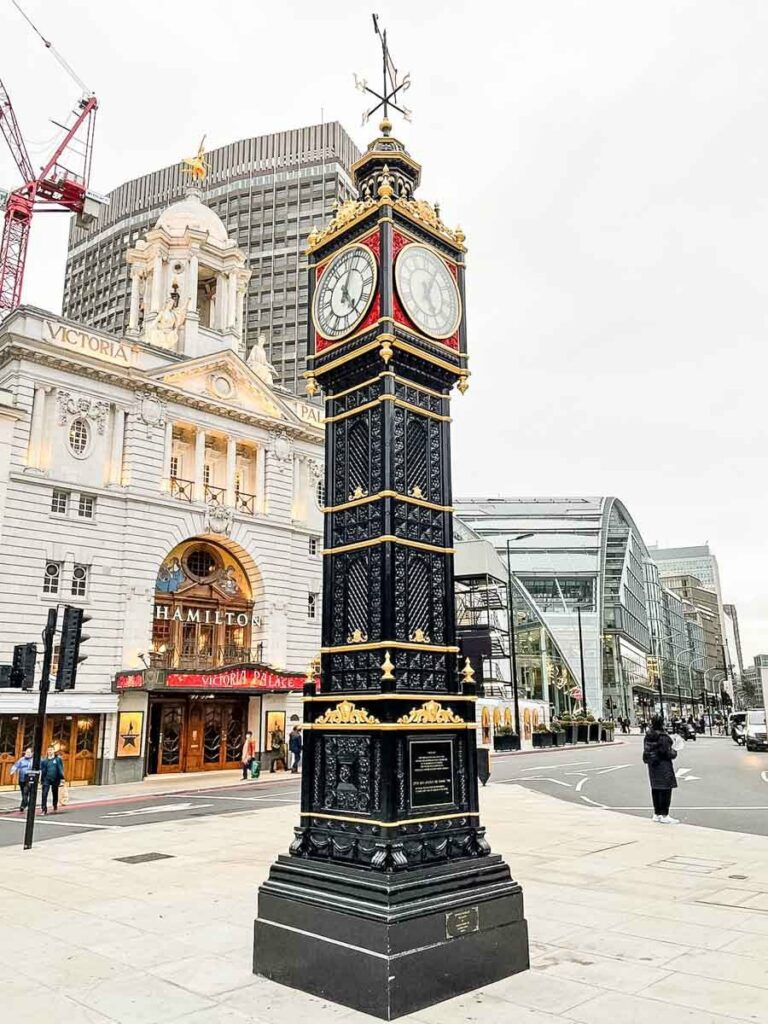
Little Ben was built by Gillett & Johnston of Croydon and unveiled on 14th March 1892, commissioned by the Vestry of St George’s Hanover Square as a public timepiece. The location was deliberately chosen: Victoria Station sits in a Big Ben blindspot, where commuters rushing for their trains lose sight of the clock at Westminster. Little Ben was the solution.
Here’s a surprise: the black and gold colour scheme you see today is wrong. The clock was originally painted in three shades of green, with gold detailing. The shift to black happened gradually from the 1930s onwards, most likely as a result of London’s notorious smog and industrial pollution, which left the original paint looking darker and dirtier over time. Decorators responded by painting over it, and generations of Londoners grew up assuming the black was original. It isn’t.
Also worth knowing: the clock mechanism is not, as you might assume, behind the clock faces. It’s elsewhere in the tower entirely, which is one of those details that makes Little Ben slightly weirder than it first appears.
The Seychelles connection
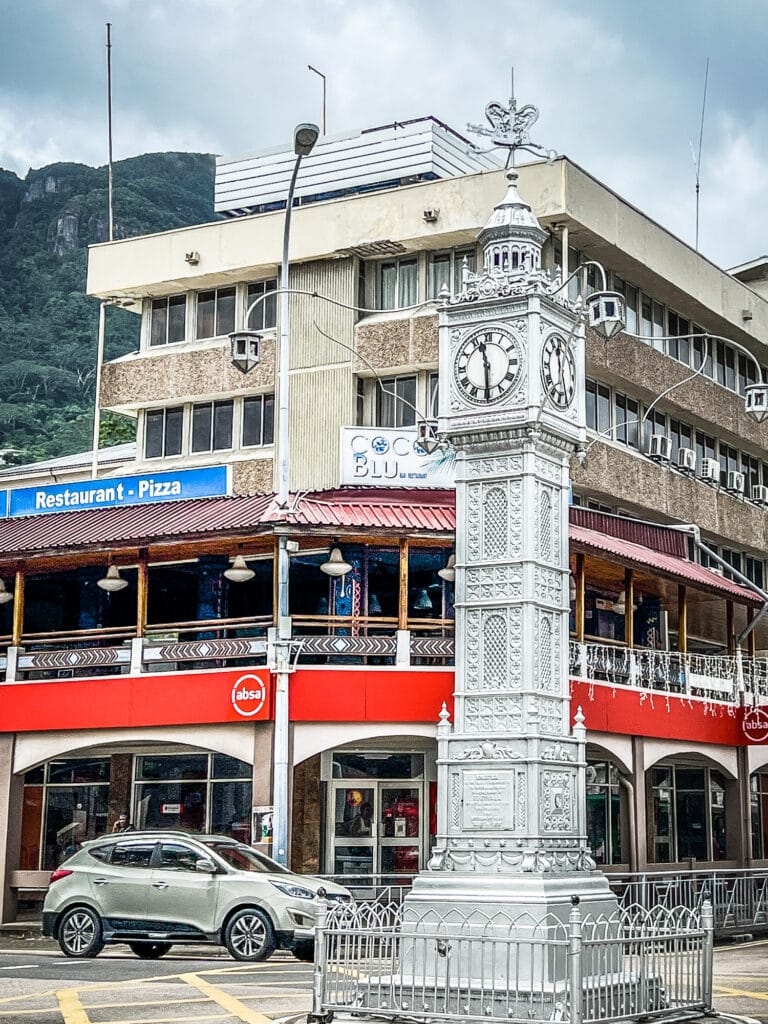
Gillett & Johnston were so confident that the design would be a hit that they registered it as a pattern and sat back waiting for orders to pour in. They didn’t. Only a handful of replicas were ever sold.
The most famous surviving example stands in Victoria in Mahé, the capital of the Seychelles, where a silver-painted replica called Lorloz was erected in 1903 to mark Queen Victoria’s Diamond Jubilee of 1897. There is also a lesser-known replica in South Norwood, which almost nobody knows about, which is exactly the kind of detail that makes us love London.
The French connection
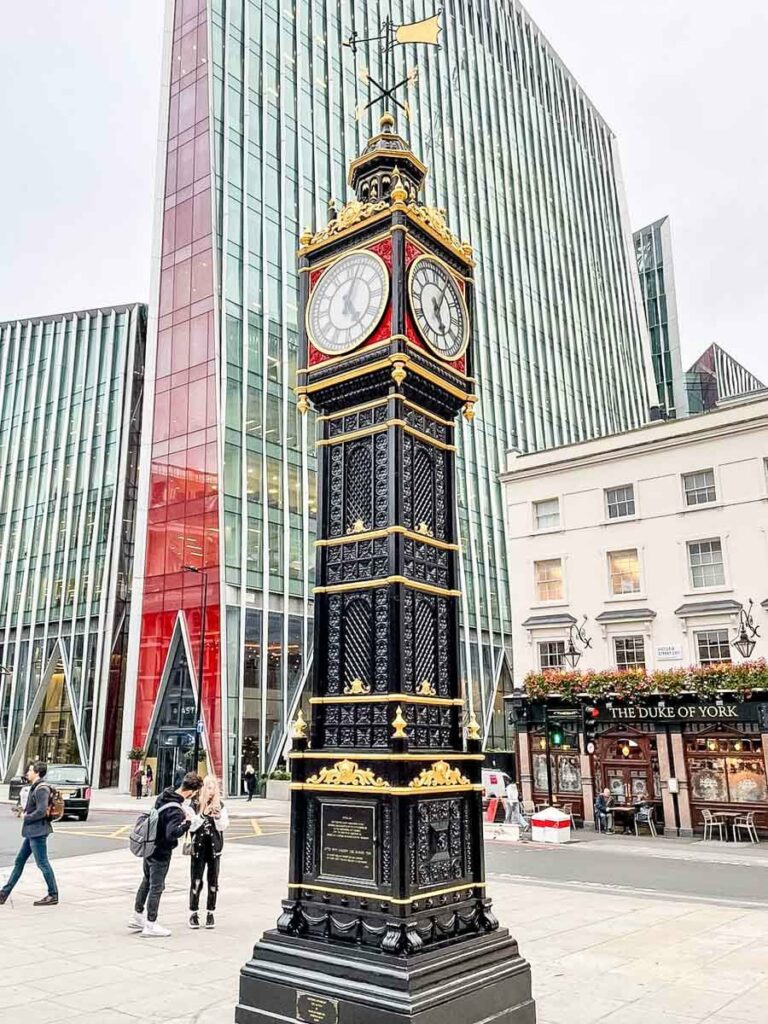
The couplet on the body of the clock reads:
My hands you may retard or may advance, My heart beats true for England as for France
This isn’t purely decorative. The clock was originally intended to permanently show British Summer Time rather than switching back in winter, meaning it would show the correct time for France during the winter months. Victoria Station was, at the time, a popular departure point for French travellers heading to the boat trains for Calais, and the clock became a well-known meeting spot for French expats in London.
The French connection runs deeper: when Little Ben was restored and re-erected in 1981, the work was partly funded by French oil company Elf Aquitaine, offered as a gesture of Franco-British friendship to mark the wedding of the Prince of Wales and Lady Diana Spencer. Not the most obvious way to celebrate a royal wedding, but here we are.
A slightly troubled history
Despite being first unveiled in 1892, Little Ben was removed in 1964 when road-widening works at Victoria made it impractical to keep it in place. It sat in storage for seventeen years before being restored and re-erected in 1981, at which point it was given a Grade II listing in 1987.
Then in 2012 it came down again, held in storage while Victoria Station underwent its major upgrade works. Smith of Derby restored it again and it went back up in 2016, at which point the original plan to keep it permanently on British Summer Time was quietly abandoned. It now simply tells the correct time, like a normal clock, which feels like a missed opportunity but is considerably less confusing.
How to visit
Little Ben stands on a traffic island at the junction of Vauxhall Bridge Road and Victoria Street, right outside the main entrance to Victoria Station. You can’t exactly miss it, though apparently many people do.
If you want a decent photograph without a dishevelled commuter in it, avoid rush hour. You’re welcome.
The London x London Take: Little Ben is one of those objects that rewards knowing the story. It looks like a quirky Victorian street fixture. It’s actually a Franco-British diplomatic gesture built on a ventilation shaft, originally painted the wrong colour, missing a clock mechanism where you’d expect to find one, with a silver twin in the Seychelles. London, never change.
Need to Know
- Where: Junction of Vauxhall Bridge Road and Victoria Street, London SW1E 5LA
- Nearest tube: Victoria (Victoria, District and Circle lines)
- Entry: Free, it’s a clock on a traffic island