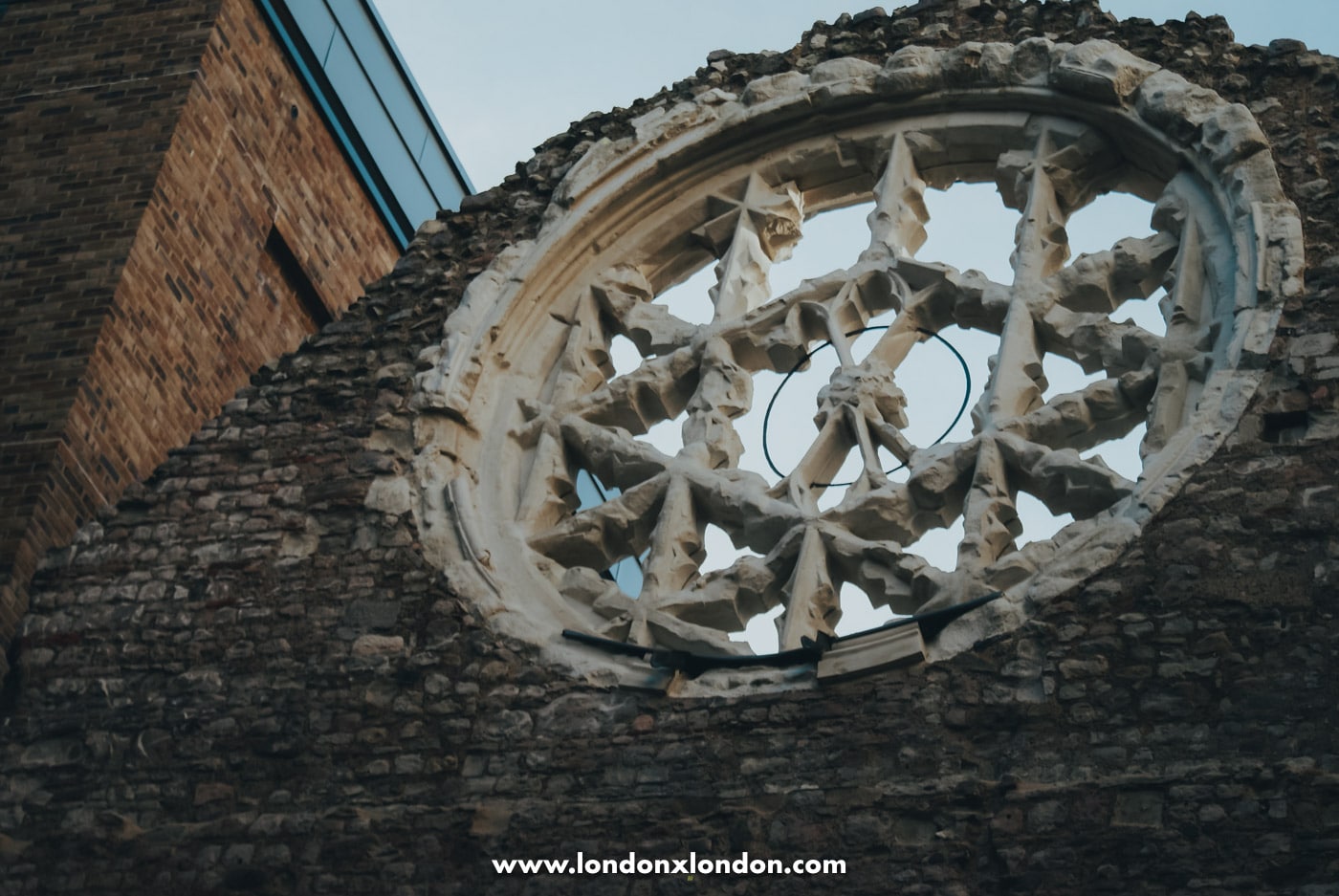
We track down the history of Winchester Palace and the dark history of its bishop pimp.
Tucked away behind Southwark Cathedral and Borough Market in London Bridge, the ruins of Winchester Palace are a hint of the building’s former glory. We must have walked past them a hundred times over the years, always stopping for a look, always meaning to actually find out the story behind that lone wall and its rose window. So we finally did. Turns out it’s genuinely one of the better dark histories in London.
History of Winchester Palace
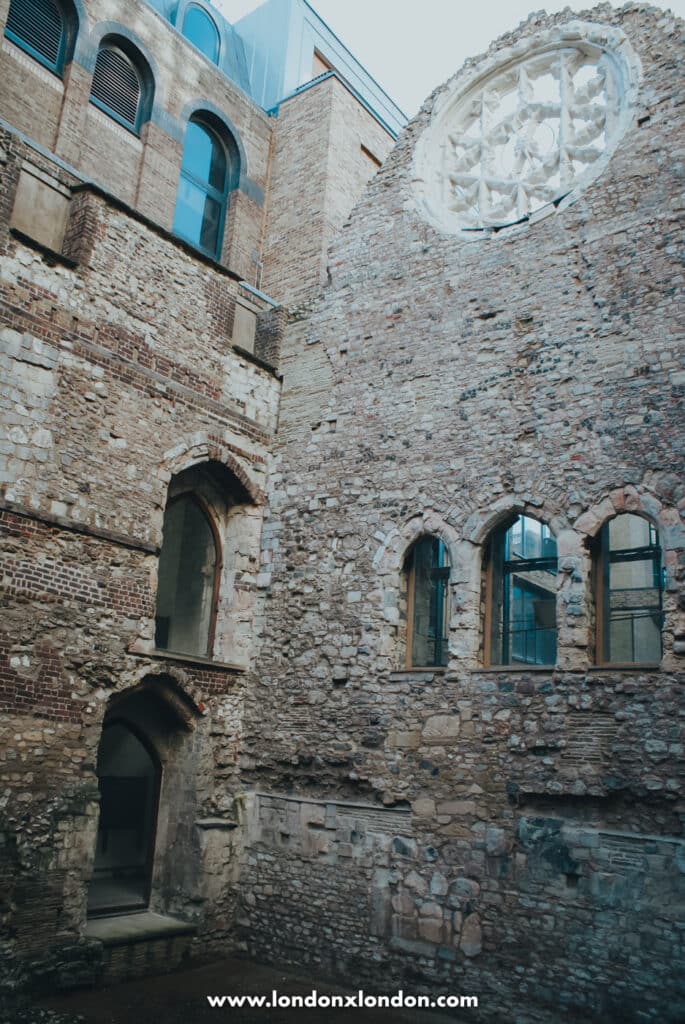
Built in the 12th century, the Bishop of Winchester lived in the palace from 1140 to 1626.
At the time it was founded by Bishop Henry de Blois, Winchester was the Saxon capital of the country and the bishop’s London palace was suitably lavish. It occupied a site of over ten acres, difficult as that is to imagine from the single remaining wall we see today.
Henry de Blois was no ordinary bishop. A grandson of William the Conqueror and the younger brother of King Stephen, he trained as a monk at Cluny before his uncle Henry I made him Abbot of Glastonbury in his twenties, then Bishop of Winchester three years later, a special dispensation letting him hold both roles at once until his death in 1171. Winchester was the richest diocese in England, which made Henry the wealthiest churchman in the country, and he ploughed that wealth into an extraordinary building spree that included the Winchester Bible, much of Wolvesey Castle and the Hospital of St Cross, alongside his London palace. He also had a genuine claim to kingmaker status. It was Henry who secured the throne for his brother Stephen in 1135 over the rival claim of Empress Matilda, then spent the years of civil war that followed, a period historians call The Anarchy, switching sides once before returning to Stephen’s camp for good.
The section still standing is the remains of the 12th century Great Hall, complete with its later 14th-century rose window.
Powerful bishops would come and stay when passing through London and it even hosted some royal guests and at least one royal wedding reception, that of King James I of Scotland and Joan Beaufort.
Alongside the palace itself, the grounds contained a brewery, theatres, grazing areas and even a private dock for journeys along the Thames.
Alongside all this splendour and glory, a distinctly less savoury affair lurked in the background: the stews (brothels) licensed by the bishop that proliferated in the area.
One such stew sat next to nearby Cross Bones Burial Ground, created for the burial of the prostitutes who, though licensed by the bishops, were not allowed to be buried on consecrated ground.
The palace itself flourished for over 500 years, but its fortunes ran out in the 17th century. Bishop Lancelot Andrewes died at Winchester Palace in 1626, and the building fell out of favour soon after, serving briefly as a prison before it was sold in 1649 to a merchant named Thomas Walker, who carved the once-grand halls up into warehouses and low-cost tenements.
In the early 1800s, fire ravaged the surrounding buildings, and in the process exposed the Great Hall’s rose window for the first time in generations. The site was then largely forgotten about again, and it took until the 1980s, when the surrounding area of Southwark was redeveloped, for archaeologists to properly excavate it and reveal the full extent of what remained. The rose window itself was restored in 1972.
Eventually the ruins were entrusted to the care of English Heritage, and Winchester Palace is now protected as a Scheduled Ancient Monument, considered one of the last great remnants of mediaeval London.
The Liberty of the Clink
There’s one unanswered question bothering us here: how did a bishop end up functioning as the neighbourhood pimp? The answer ties many of the most important people of the day into a pretty shady deal.
The Clink first comes about when a liberty was granted to the Priory of Bermondsey in 1104. A liberty was essentially a bit of land controlled by the bishops, not policed by local law.
In 1149 this liberty was sold to Henry of Blois, the Bishop of Winchester and resident of Winchester Palace, which is where this little chapter of history turns dark. Henry of Blois used some friends in high places to turn the Clink into a place of nefarious activity and get this: it was the king of England himself that licensed the illicit activities.
It’s not clear why King Henry II did what he did. Chances are he sagely saw prostitution as a problem that could not be eliminated, but could be controlled. If so, the Clink would’ve made the ideal spot for some kind of red light district as it was out of the City of London’s jurisdiction.
The Clink became more famous than Winchester Palace itself, ladies of the night taking on the name Winchester geese. Many of these Winchester geese are the ones buried in Cross Bones Cemetery.
Their names even coined a few phrases. Goose bumps may actually get its name for a slang reference to venereal disease caught from the Winchester geese. To be “bitten by a goose” meant the same.
Practical Information and Map
Address: Winchester Palace, Pickfords Wharf, Clink Street, London SE1 9DG
Opening times: There are no opening times to Winchester Palace. You just walk by it on Clink Street, near the Golden Hinde ship.