Senate House, the Art Deco tower behind the British Museum, was the real-life headquarters of Britain’s wartime propaganda ministry, the likely inspiration for Orwell’s Ministry of Truth, and a filming location for both Batman Begins and The Dark Knight Rises.
Sitting behind the British Museum in Bloomsbury, Senate House is one of the finest examples of Art Deco architecture in the capital, and if you didn’t already know how much we adore this architectural style, now you do.
But Senate House is more than just a pretty face. This building has played a genuine role in shaping the century, from a crucial outpost in the Second World War to influencing some of the most enduring dystopian fiction in the English language.
Why visit Senate House?
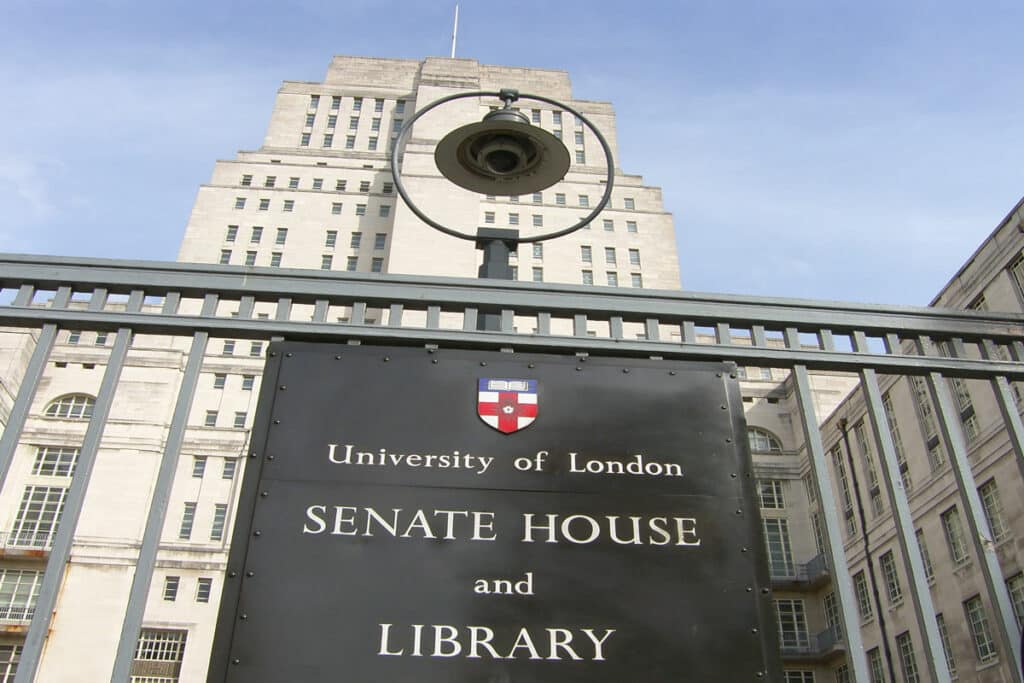
Why should you visit one of the most influential buildings in the capital, we hear you ask? Allow us to explain.
Popular influences
First of all, the building’s unique design has led to a string of Hollywood productions filming there, Batman Begins, The Dark Knight Rises, The Theory of Everything, and Doctor Who among others.
And, who doesn’t want to walk in the footsteps of Christian Bale?
Oh, and if you’re a bookworm like us, you’ll have no doubt read George Orwell’s Nineteen Eighty-Four, the dystopian novel that famously coined the phrase ‘Big Brother’.
It’s believed that Senate House inspired the Ministry of Truth in the novel, particularly because Orwell’s wife, Eileen, worked in the building’s Censorship Department during the war. Senate House inspired a second wartime novel too: Graham Greene’s The Ministry of Fear, published the same year the war ended, later became a 1944 film directed by Fritz Lang.
Architectural Significance
Upon completion, Senate House was the tallest secular building in Britain after St Paul’s Cathedral.
It also became one of the first large buildings in the world to be fully heated by electricity. It’s Grade II* listed, the higher of the two grades reserved for particularly important buildings, a status it’s held since being recognised as a structure of exceptional architectural significance.
In recent years, the University of London undertook a £55 million refurbishment, overhauling the original Art Deco features and grand halls into functioning event spaces. Don’t worry though, the building still retains all of its authentic charm. New tech was also installed, we’re sure Orwell would be brimming with new novel ideas.
The History of Senate House
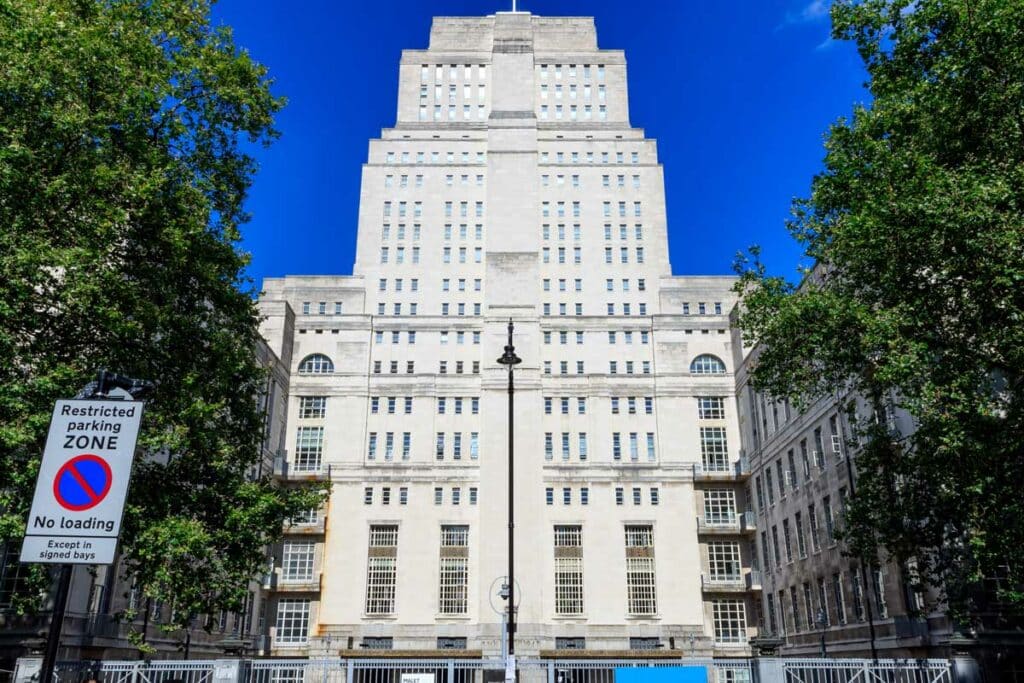
Sir William Beveridge is responsible for this striking building. As Vice-Chancellor of the University of London in the late 1920s, he had a vision for a new home for the university, which had begun to outgrow its scattered campuses around the city, and was keen for the new location to become a genuine architectural feature of the city.
Beveridge convinced the Rockefeller Foundation to donate £400,000 towards the project, and in 1927 the university bought a site behind the British Museum from the Duke of Bedford’s estate. Charles Holden, already well known for his London Underground station designs, was brought in to design the new building. Construction began in 1932, and King George V laid the ceremonial foundation stone on 26 June 1933. The project wasn’t without tragedy: in November 1936, University Principal Sir Edwin Deller died after a skip fell on him during a site inspection.
The original design stretched much further than what exists today, but Holden had to rethink the plans as the Second World War approached, and in the end only the main building and library were completed.
When war broke out in 1939, Senate House became home to a brand new government department: the Ministry of Information. This department was responsible for censorship and propaganda for the duration of the war, and the roof of Senate House served as an observation post for the Royal Observer Corps. The building took a real battering during the Blitz, hit by bombs roughly nine times, with one strike destroying the Theses Room in the south wing. Inside, a press room for every London newspaper operated out of Beveridge Hall, and it’s here that the Ministry’s most famous slogan, “Keep Calm and Carry On”, was developed in the summer of 1939, though it went unused and unseen by the public until a copy resurfaced decades later.
Today, Senate House is a conference centre, London Fashion Week venue, and home to a range of university classes. It’s one of the most versatile buildings in the capital.
By design: peeking behind the architecture of Senate House
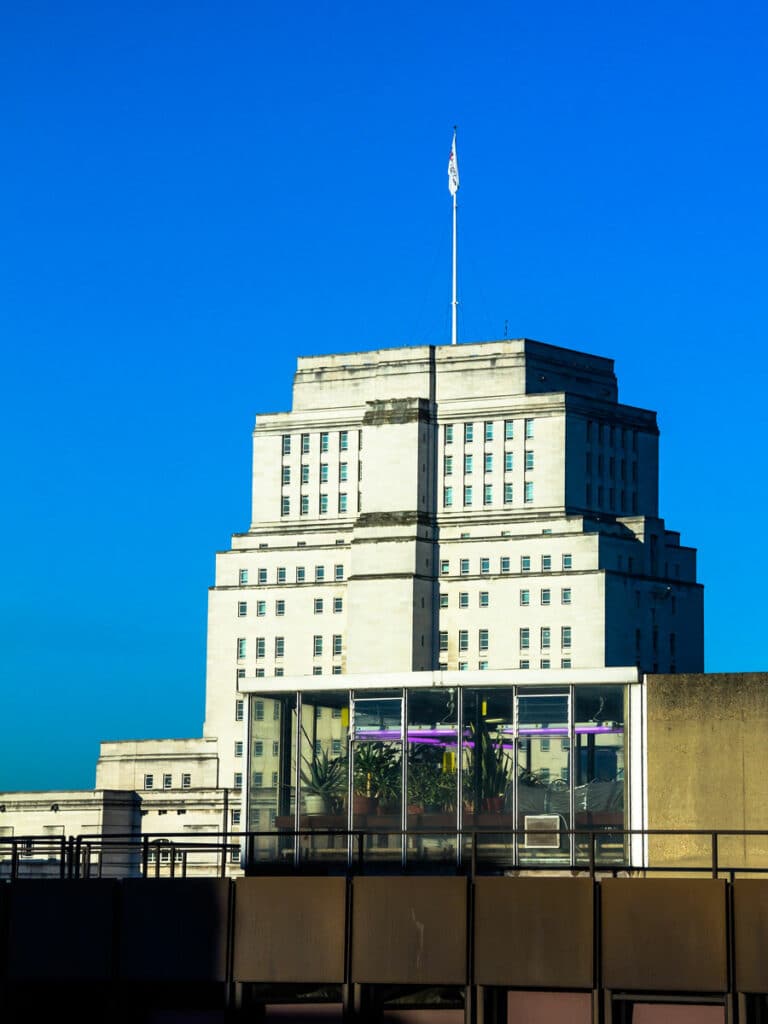
It’s hard to miss Senate House, and we’ve got Charles Holden to thank. Holden was required to design a building that would sit comfortably alongside the British Museum and UCL nearby.
Though you can’t please everyone, and this building was rather controversial at the time, gathering quite a crowd of critics. Art Deco was hugely fashionable in the late 1920s, having arrived from Paris as an opulent, wealthy style, but Holden himself questioned whether the building was too modern, or too traditional.
We’re glad he stuck it out, because the end result is remarkable. Senate House was constructed from Portland stone, Travertine marble, English walnut and South American cypress, some of the finest materials available at the time. Inside, even the smallest details were carefully considered, embellished ceilings, ironwork and bespoke furniture that all match the building’s overall design.
The London x London Take: Most people walk past Senate House assuming it’s just another university building, which is exactly what makes it worth a proper look. Few buildings in London can claim to have genuinely shaped a piece of literature as significant as Nineteen Eighty-Four while also hosting Christian Bale in a cape. Time a visit around the Open House Festival in September if you want to actually get inside, the rest of the year it’s really an exterior and library visit rather than a full building tour.
Practical information for visiting Senate House
The public library on the 4th floor is open to visiting researchers, with self-service access running through the summer months, though some services are restricted to members during that period, check the library’s current opening hours before visiting.
For a proper look inside, the Open House Festival runs free, drop-in tours of Senate House itself on Saturday 12 and Sunday 13 September 2026, alongside separate, ticketed tours of Senate House Library that need booking in advance.
Senate House sits roughly halfway between Goodge Street and Russell Square tube stations, a five minute walk from either.