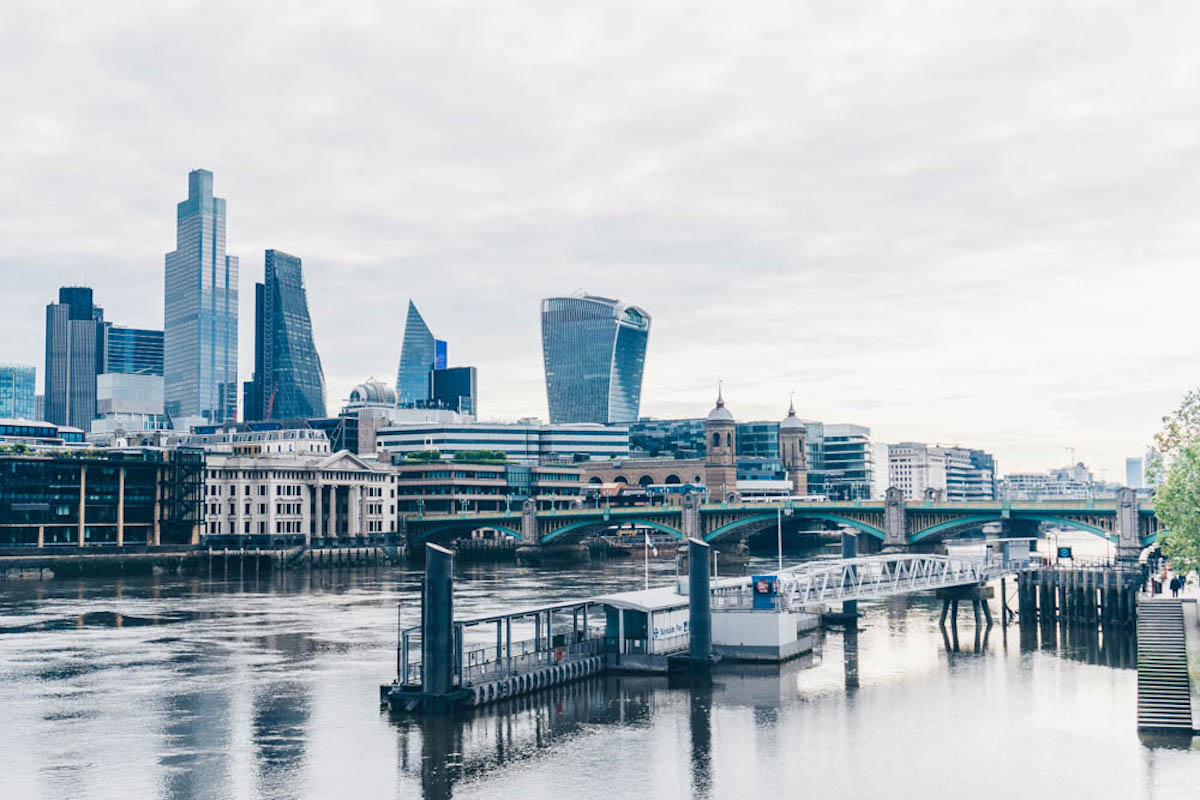
London – we all know it. That massive heap of buildings, parks and weird (but wonderful) people who can’t look at each other on public transport. No wonder it’s attracted a fair few nicknames over the years.
We’ll wager you’ve heard of some of London’s nicknames, like The Big Smoke, but maybe not some of the others. The Great Wen, anyone?
“What’s in a name? That which we call a rose by any other name would smell as sweet.” William Shakespeare, Romeo and Juliet.
Whatever Shakespeare’s thoughts on the immateriality of names, London’s nicknames tell you a lot about the city’s past. Let’s explore.
The Great Wen
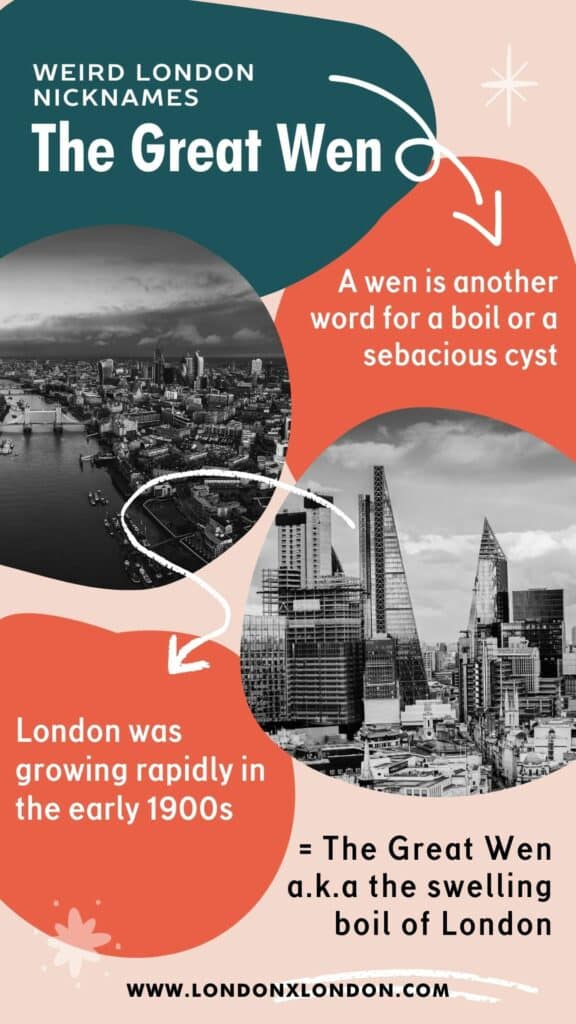
We’ll put our hands up and say that we hadn’t ever actually heard someone call London by the nickname of The Great Wen, but the story behind it is too good to pass up.
A wen is another word for a boil or a sebaceous cyst.
London was growing rapidly in the early 1800s. So William Cobbett, an English pamphleteer, journalist, Member of Parliament and farmer, came up with the nickname The Great Wen to refer to the expanding city, which he felt was swallowing up villages and farmland like a cancerous growth on the countryside.
The Swelling Boil just doesn’t have the same ring, we suppose.
The Big Smoke, The Smoke or The Old Smoke
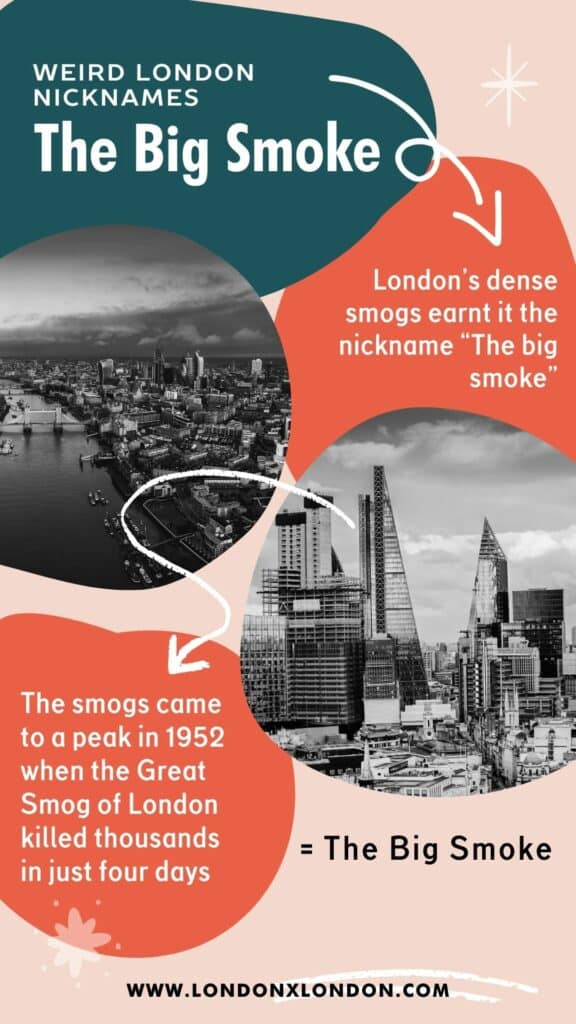
Much as we might complain about the poor air quality in London today, it’s nothing to the great smogs that used to plague the capital. London’s always had a bit of a reputation for being foggy and grey, but this was vastly increased by the Industrial Revolution, which led to the rapid building of millions of homes and factories, and millions of air-polluting chimneys alongside them.
The problem kept getting worse and worse until 1952, when The Great Smog of London killed thousands of people when it raged for four days straight between the 5th and 9th December. It resulted in sweeping air pollution reforms including the Clean Air Act of 1956. The nickname, however, stuck.
The City
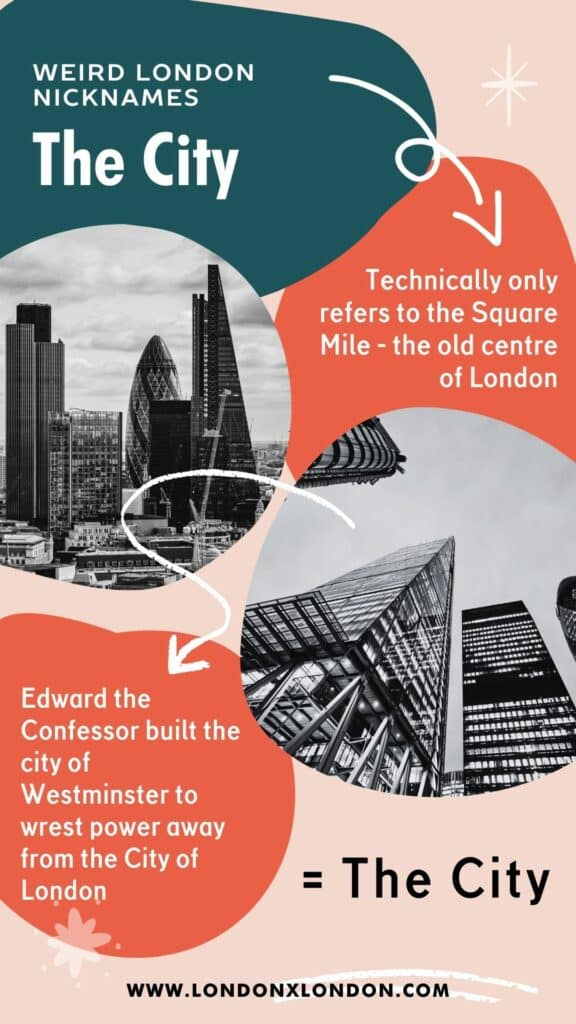
While London is clearly a city, and a pretty sprawling one at that, The City technically refers only to the Square Mile that was the historic centre of London. It’s where you’ll find the majority of London’s Roman ruins and many of the buildings of bygone days, and even today it’s run by the City of London Corporation, has its own police force and its own Lord Mayor.
Prior to the 11th century, much of the country’s power and authority rested within The City. A fact that Edward the Confessor didn’t like very much. He started building what was to become The City of Westminster to wrest power away from The City of London, and started a centuries-old beef that still means the monarch is not allowed to step foot in the City of London without the permission of its Lord Mayor.
The Square Mile
Related to The City but distinct from it: The Square Mile refers specifically to the financial district at the heart of London, which quite literally covers approximately one square mile. Today it houses the Bank of England, Lloyd’s of London, the Stock Exchange and more financial institutions per square foot than anywhere else on the planet. When bankers and traders say The Square Mile, they don’t mean size. They mean power.
The Swinging City
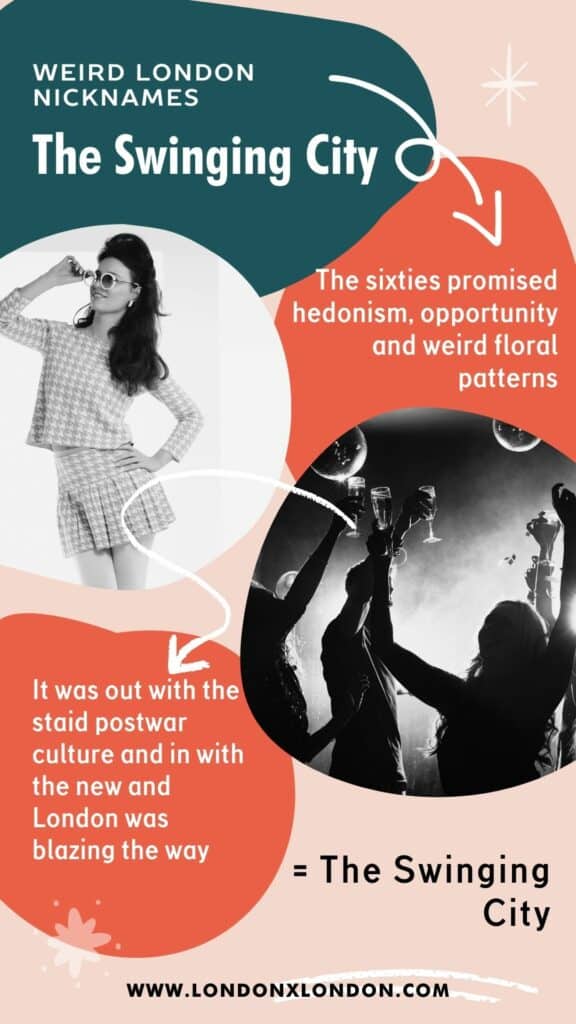
It’s hard to believe it in a day when it costs a small fortune to buy a stamp-sized flat in London, but the city was at the centre of the cultural revolution that shook up the UK in the 1960s. Hedonism, opportunity, weird floral patterns: out with the staid postwar culture and in with the new, and London was blazing the way.
You know you’re doing something right as a city when the then Editor-in-Chief of Vogue, Diana Vreeland, calls you “the most swinging city in the entire world.” Beat that.
The Old Lady of Threadneedle Street
Strictly speaking this is a nickname for the Bank of England rather than the city itself, but it gets used for London’s financial world more broadly, so it earns its place here. The Bank of England has sat on Threadneedle Street since 1694, and the nickname first appeared in a political cartoon in 1797, depicting the then Prime Minister William Pitt the Younger in a rather compromising position with an elderly lady sitting on a chest of gold. The old lady was the Bank. The cartoon was not subtle. The nickname stuck.
The Metropolis
Used in the 19th century when London was the centre of the British Empire and ruled, directly or indirectly, over a quarter of the planet’s population. H.G. Wells used it to capture the city’s scale and strangeness. At its Victorian peak, London was the largest city in the world by some distance, and Metropolis felt like the only word that came close to doing it justice. It doesn’t get used much anymore, which is probably fair given that several cities have since overtaken it in size, but it captures something about the sheer ambition of what London was trying to be.
Reykjavik-on-Thames
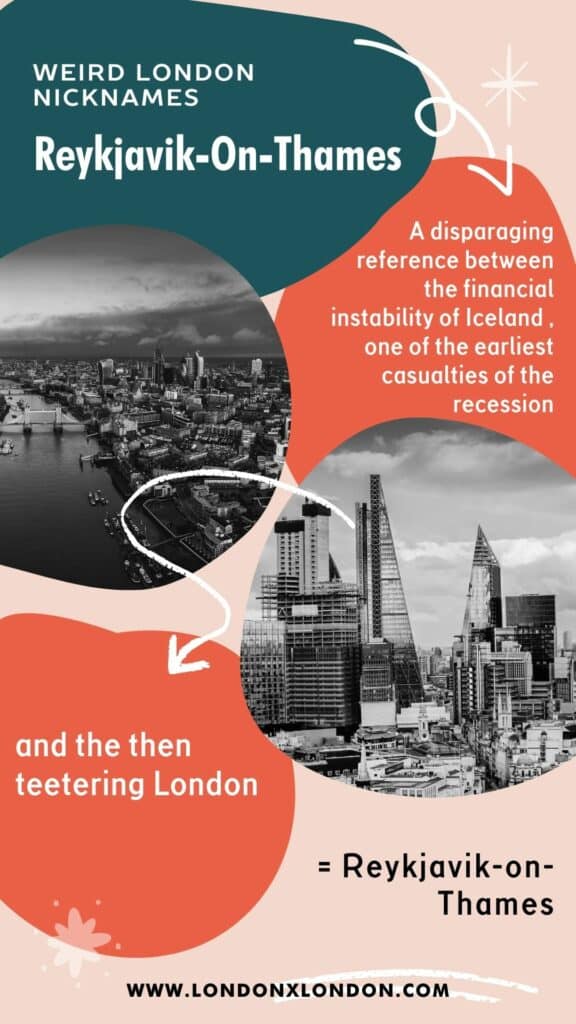
This one was thrown up by the 2008 financial crisis, a disparaging reference to the similarities between the financial instability of Iceland, one of the earliest casualties of the recession, and a then-teetering London.
This rather scathing quotation from the New York Times in 2009 says it all:
“An island nation that bulked up on debt and lived beyond its means. A plunging currency. And a financial system edging toward nationalization. With the pound at a multi-decade low and British banks requiring ever-larger injections of taxpayer cash, it is no wonder that observers have started to refer to London as “Reykjavik-on-Thames.”
Ouch. Not so swinging now.
Londontown
Don’t get too excited because:
- This one isn’t even that interesting and
- It’s factually incorrect anyway (the horror)
Nicknaming London “Londontown” (oh, how original) was popularised by a rather gushy wartime song called A Nightingale Sang in Berkeley Square, written in 1939. The factually incorrect part: nightingales don’t actually live in London. They’re rural birds. Berkeley Square has pigeons. Lovely sentiment, though.
“But I’m perfectly willing to swear
That when you turned and smiled at me
A nightingale sang in Berkeley Square
The moon that lingered over London town.”
Saccharine sweet.
And Finally… Londinium to London
There’s a long history behind where London got its name, but the short version goes something like this. The Romans invaded Britain in 43 AD, founded a trading settlement on the northern bank of the Thames and called it Londinium. In the many years that followed, it got called all kinds of things: Londinio, Londini, Londiniensium and, inexplicably, Augusta, before everyone agreed to settle on London. Which took a while, all things considered.