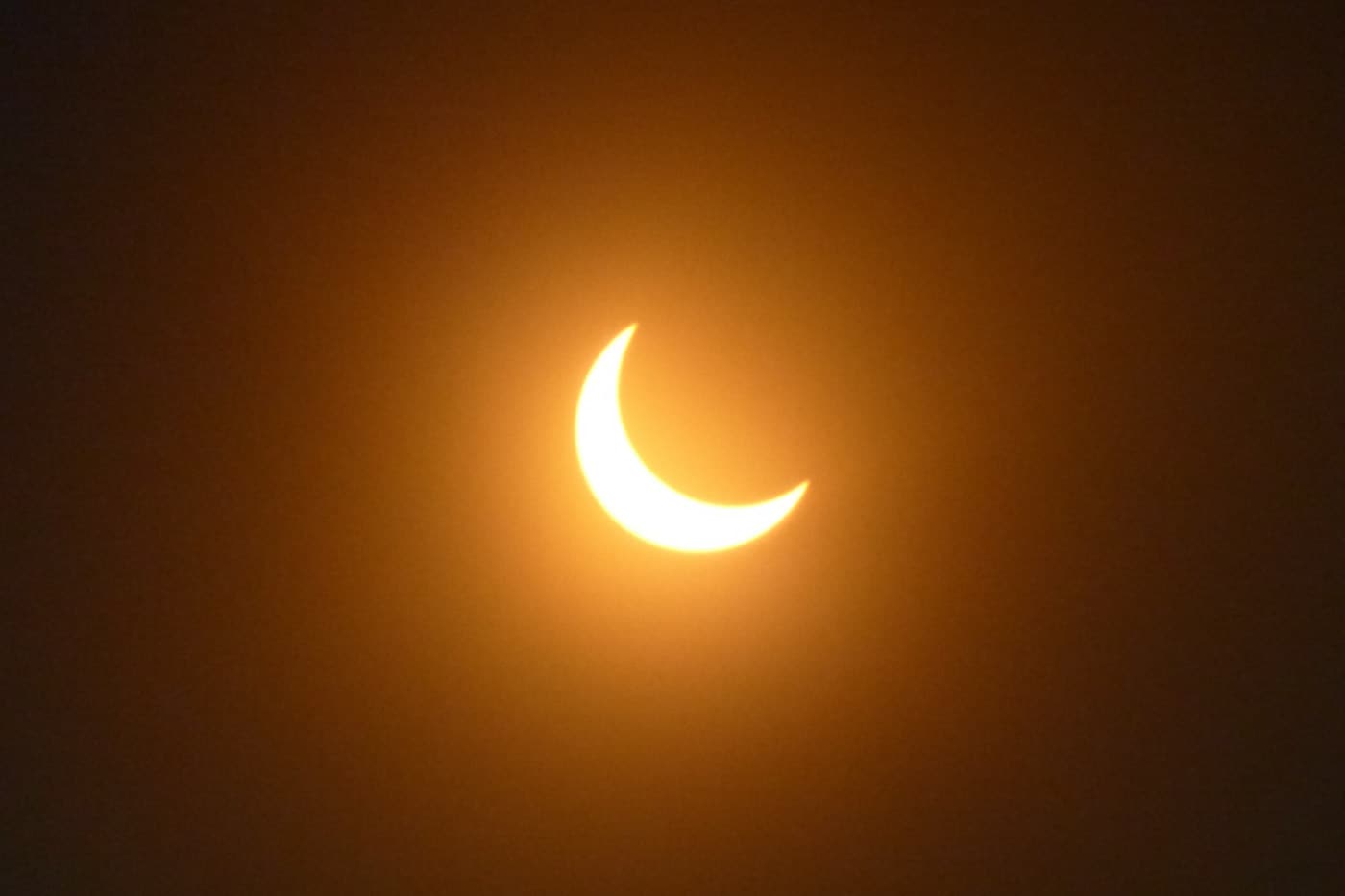
On Wednesday 12 August, London will see up to 90% of the Sun covered by the Moon, the most dramatic solar eclipse visible from the UK since 1999, running from early evening into sunset.
Need to Know
- When: Wednesday 12 August 2026, 6.17pm to 8.06pm in London, maximum coverage at 7.12pm
- How much of the Sun will be covered: around 90% in London, up to 95-97% further south-west in Cornwall and Ireland
- Is it safe to look at: never directly, even at maximum coverage, only through certified eclipse glasses, a filtered solar telescope, or a projected image
- Where to watch in London: the Royal Observatory Greenwich is running a ticketed in-person viewing session plus two free YouTube livestreams, one with astronomer commentary, one without
What time is the eclipse in London?
The Moon starts crossing the Sun’s disc, known as first contact, at 6.17pm. Coverage builds steadily to its maximum of roughly 90% at 7.12pm, before the Moon moves off again and the eclipse ends at 8.06pm. Because it’s happening as the Sun sets, the eclipse will sit low on the western horizon the whole time, so a high point with a clear view west matters more than usual.
Primrose Hill, Greenwich Park and Alexandra Palace all work. London’s 90% is respectable but not the best on offer this time round, the south-west tip of Ireland gets closer to 97.5%, and a narrow path across Greenland, Iceland and northern Spain will see a full total eclipse.
Is it safe to watch?
Only with the right equipment. Certified eclipse glasses (look for ISO 12312-2 printed on the frame, and don’t reuse old or scratched pairs) are the simplest option. A solar telescope fitted with a proper filter works too, but a normal telescope or regular sunglasses will not protect your eyes and can cause serious damage. If you don’t have either, a pinhole projector, two sheets of paper, a colander, or even the natural gaps between tree leaves, lets you watch the Sun’s reflection safely without looking anywhere near it directly.
Where to watch it in London
The Royal Observatory Greenwich is the obvious first stop. From 4pm, the Flamsteed Astronomy Society runs a solar observing session in the Observatory’s Dolphin Sundial area, with members on hand to explain what’s happening and answer questions as the eclipse builds towards its maximum, standard Observatory admission applies, though Flamsteed members get in as part of their existing membership, and the session runs until 8pm, weather permitting.
If you can’t get there in person, there are two separate livestreams to choose from, both broadcast from the roof of Flamsteed House. From 6.10pm, the Royal Observatory Greenwich’s YouTube channel carries the eclipse with commentary from two of the Observatory’s astronomers, wrapping up shortly after the eclipse reaches its maximum. For anyone who’d rather watch without the talk-through, Royal Museums Greenwich’s YouTube channel runs a quieter, commentary-free feed that stays live until the eclipse ends.
Elsewhere in the city, keep an eye on local astronomical societies, several run informal glasses-and-advice sessions from parks and open spaces on the day.
- South London Astronomical Society at Riddlesdown Common, Purley: eclipse glasses to borrow, three specialist telescopes and a local astronomer on hand, £10 per family of up to five
- Croydon Astronomical Society at Kenley Airfield, School Common in Warlingham, and Bingham Recreation Ground in Addiscombe, weather permitting
- Loughton Astronomical Society across two viewing spots in Chingford and Theydon Bois, with eclipse glasses available to borrow
- SW London Stargazers gathering informally at Tooting Bec, organised via Meetup
- Hampstead Scientific Society, whose observatory is blocked by trees on the day itself, so instead opened its doors on 8 and 9 August to hand out solar glasses and answer questions ahead of time
When’s the next one?
Not for a while. The next total solar eclipse visible from the UK isn’t due until 2090. The closest the British Isles gets before then is 3 September 2081, when up to 99% of the Sun will be covered, best seen again from Cornwall. A partial lunar eclipse follows this one on 28 August, visible from the UK in the very early hours from 3.33am, when the Moon turns a reddish “blood moon” colour as it passes through Earth’s shadow.
The London x London Take: 90% coverage sounds like a footnote next to a full eclipse, but it’s the closest London gets for another 64 years, and the low, setting sun makes it visually more dramatic than the percentage suggests. Get eclipse glasses now rather than the morning of, they sell out fast every time one of these comes round. Greenwich is the best organised option in the city by some distance, book the observing session if you want expert commentary, or just turn up to a high spot with a clear west-facing view and your own glasses.